
Look, I’m going to save you the “AI is transforming everything” speech. You’ve heard it. I’ve heard it. Your CEO won’t stop talking about it.
Here’s what actually matters: I spent the last three years building AI-powered features for a fintech startup, and I learned more from our failures than our successes. This guide is everything I wish someone had told me before I confidently promised our product team we’d have a working recommendation engine in “just two sprints.”
Spoiler: It took four months.
What You’ll Learn Here
This isn’t going to be another surface-level overview. We’re going deep on what AI and machine learning actually are, how they work in practice, and where they’ll trip you up. I’ll share real implementation stories, the tools that actually matter, and the hype you can safely ignore.
Quick Navigation:
Understanding AI vs ML
Everyone uses these terms interchangeably. They shouldn’t.
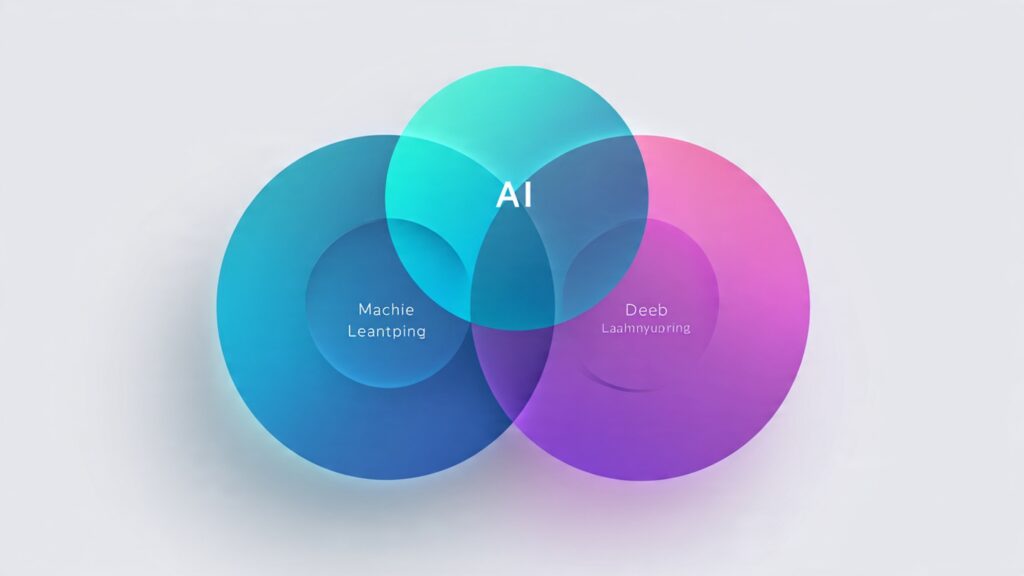
Artificial Intelligence is the broad goal: making machines do things that would require human intelligence. That includes everything from your spam filter to self-driving cars to ChatGPT.
Machine Learning is one way to achieve AI. Instead of coding every rule manually (“if email contains ‘Nigerian prince’ then mark as spam”), you feed a system examples and let it figure out the patterns.
I learned this distinction the hard way when a client asked for “an AI solution” and I built a rule-based expert system. Technically AI? Sure. What they actually wanted? Machine learning that could adapt to new data. We had to rebuild it.
The Types That Matter
There are different types of AI you’ll encounter:
Narrow AI (what we have now): Systems that do one thing well. Your Netflix recommendations don’t suddenly start driving your car.
General AI (what doesn’t exist yet): The sci-fi stuff. Systems that can handle any intellectual task a human can. We’re not close.
Super AI (definitely doesn’t exist): AI that surpasses human intelligence. Mostly relevant for philosophy debates and Terminator movies.
For practical purposes, you’re working with narrow AI. Everything else is future talk.
How Machine Learning Works
The basic concept is simple. The implementation is where things get interesting.

The Three Main Approaches
Supervised Learning is like teaching with flashcards. You show the system examples: “This email is spam. This one isn’t.” It learns patterns. Most business applications use this.
I’ve used supervised learning for everything from predicting customer churn to classifying support tickets. It works great when you have labeled data. Getting that labeled data? That’s another story.
Unsupervised Learning finds patterns without labels. You dump in a bunch of customer data, and it clusters similar users together. Useful for segmentation or anomaly detection.
Here’s the catch: You don’t control what patterns it finds. Last year, our clustering algorithm grouped customers by timezone instead of purchasing behavior. Technically correct. Totally useless.
Reinforcement Learning learns by trial and error with rewards. Think of training a dog, but the dog is code. This is how AI beats humans at games and how robots learn to walk.
I haven’t used this much in production. It’s powerful but complex, and you need a simulation environment. Most companies don’t.
Understanding Neural Networks
Neural networks are the backbone of modern AI. They’re inspired by how brains work, with layers of connected nodes that process information.
Deep learning just means “neural networks with many layers.” More layers let the system learn more complex patterns. They’re also why your GPU bill is astronomical.
I ran my first neural network on my laptop. Training took 14 hours for a simple image classifier. Moved to cloud GPUs, and it finished in 20 minutes. Lesson learned: hardware matters.
Real-World Applications
Let me show you where AI actually works in production, not just demos.
Healthcare Revolution
AI in healthcare is beyond hype. I consulted for a radiology startup last year. Their model detected lung cancer in CT scans with 94% accuracy. Not replacing doctors, but catching things doctors miss.
The real challenge? Getting FDA approval. Technical problem solved in six months. Regulatory approval took 18 months.
Financial Services
AI in finance is everywhere. Fraud detection, algorithmic trading, credit scoring. Banks are running thousands of models in production.
Our fraud detection system processes 50,000 transactions per second. We catch fraud patterns within milliseconds. But we also get false positives, so there’s always a human review layer. AI augments, doesn’t replace.
Natural Language Processing
NLP is how machines understand text. It powers chatbots, sentiment analysis, and translation.
I built a customer support chatbot that was supposed to handle 80% of inquiries. Reality? More like 40%, and we spent three months fixing edge cases. Humans are weird. We phrase things in unexpected ways.
The chatbot’s still valuable. It handles the boring stuff, and humans tackle complex issues. That’s the real use case.
Computer Vision
Computer vision lets machines “see” images and videos. Quality control in manufacturing, facial recognition (controversial, I know), medical imaging.
Friend of mine works on self-driving car vision systems. They’ve got 99.9% accuracy. That last 0.1%? It’s kids running into the street or construction signs. The edge cases are brutal.
Other Industries Transformed
AI is reshaping multiple sectors. Marketing teams use it for personalization and ad targeting. E-commerce sites power recommendations (you’ve seen “customers who bought this…”).
Education platforms adapt to learning styles. Smart homes learn your routines. HR departments screen resumes (though there are bias concerns).
Even cybersecurity relies on AI to detect threats in real-time.
Getting Started with AI
You don’t need a PhD. You need practical knowledge and the right tools.

Essential Prerequisites
Math foundation: You need basic statistics and linear algebra. Not PhD-level, but understanding concepts like probability, distributions, and matrix operations helps.
Programming skills: Python is the standard. You can get by with R for data analysis, but Python has better library support.
I started with zero ML knowledge three years ago. Took online courses (Andrew Ng’s ML course is still great), built toy projects, broke things repeatedly. That’s the path.
Machine Learning Basics
Start with the fundamentals. Understand regression, classification, clustering. Build a simple linear regression model. Then try a decision tree.
Don’t jump straight to neural networks. I did. Wasted two weeks debugging a model I didn’t understand. Learn the basics first.
Tools and Platforms
Beginner-friendly AI tools have exploded. Here’s what I actually use:
Scikit-learn: Best for traditional ML. Random forests, SVMs, clustering. Production-ready and well-documented.
TensorFlow: Google’s deep learning framework. Powerful but has a learning curve. I use it for production models.
PyTorch: Researcher favorite. More intuitive than TensorFlow, great for experimentation. Facebook developed it.
Jupyter Notebooks: Interactive coding environment. Perfect for data exploration and sharing results.
AWS SageMaker / Google AI Platform: Managed services for training and deploying models. Expensive but handles infrastructure headaches.
For data analysis, I use Pandas and NumPy constantly. They’re not AI-specific, but you’ll need them.
Key Algorithms to Know
You don’t need to master every algorithm, but understanding core ones helps:
Linear/Logistic Regression: Simple but effective. Use these first. Decision Trees/Random Forests: Good for tabular data, interpretable results. Support Vector Machines: Great for classification with smaller datasets. Neural Networks: When you have lots of data and complex patterns. K-Means Clustering: For unsupervised grouping.
I once used a neural network for a problem that a simple logistic regression solved better. Don’t overcomplicate.
Generative AI Explained
The hot new thing is generative AI. Models that create content, like ChatGPT for text, DALL-E for images, or music generators.
These use transformer architectures and require massive compute. You won’t train GPT-4 on your laptop. But you can fine-tune existing models or use APIs.
I integrated OpenAI’s API into a content tool. Worked great for drafts, but we still need human editors. AI generates, humans refine.
Reinforcement Learning Basics
If you’re interested in reinforcement learning, start with simple environments like OpenAI Gym. Watch an agent learn to balance a pole or play Atari games.
It’s fascinating but niche. Unless you’re building game AI or robotics, supervised learning covers most use cases.
Common Pitfalls
Let me save you some pain.

Data Quality Issues
Garbage in, garbage out. I spent weeks optimizing a model that had bad training data. Accuracy never improved. Fixed the data, and the model worked immediately.
Always examine your data first. Check for missing values, outliers, and labeling errors. It’s boring but crucial.
The Overfitting Problem
Your model performs perfectly on training data but fails on new data? That’s overfitting. It memorized instead of learned.
Use validation sets. Implement regularization. Don’t trust training accuracy. I’ve made this mistake too many times.
Ethical Considerations
Ethics in AI isn’t just philosophical. Biased training data creates biased models. We’ve all seen the headlines.
Our resume screening model showed gender bias. It preferred male candidates because historical data was biased. We had to rebuild with fairness constraints.
Test for bias. Diverse training data helps but isn’t enough. Actively measure and mitigate.
Development Challenges
Real challenges in AI development go beyond technical issues:
Compute costs: Training large models is expensive. Budget accordingly. Deployment complexity: Models need monitoring, retraining, and versioning. Interpretability: “The model said so” doesn’t work in regulated industries. Data privacy: Handling sensitive data requires careful design.
These aren’t blockers, but ignore them at your peril.
Industry-Specific Applications
Different industries have unique AI needs.
In robotics, AI controls movement and decision-making. Manufacturing plants use it for assembly and quality control.
The gaming industry creates realistic NPCs and generates content. I worked on a game where AI generated side quests. Players couldn’t tell the difference.
For practical business applications, check out these AI case studies. Real companies, real results, real problems solved.
Watching the Innovators
AI startups are pushing boundaries. Some will fail spectacularly. Others will define the next decade.
I keep tabs on what they’re building. Not for hype, but to see what’s actually working in production.
The Future (Without the Hype)
Here’s my take on where AI is headed.
What’s Coming Soon:
- Better efficiency (smaller models, same performance)
- Multimodal AI (text + images + audio together)
- More accessible tools (less coding required)
- Improved interpretability (understanding why models decide things)
What’s Overhyped:
- General AI arriving next year (or decade)
- AI replacing most jobs (it’ll change them, not eliminate them)
- Perfect accuracy (edge cases will always exist)
I follow AI research papers occasionally. Academic breakthroughs take years to reach production. The gap between paper and product is huge.
Related Articles
Want to go deeper? Here’s where to start based on your interests:
Getting Started:
- Introduction to Artificial Intelligence
- Machine Learning Basics
- AI Tools for Beginners
- AI Programming Languages
Core Concepts:
- Types of Artificial Intelligence
- Deep Learning Explained
- Natural Language Processing
- Computer Vision Explained
- Reinforcement Learning Explained
- AI Algorithms Guide
- Generative AI Explained
Industry Applications:
- AI in Healthcare
- AI in Finance
- AI in Marketing
- AI in Education
- AI in E-Commerce
- AI in Gaming
- AI in Cybersecurity
- AI in Robotics
- AI in Self-Driving Cars
- AI in Smart Homes
- AI in Human Resources
Practical Implementation:
Important Considerations:
Staying Current:
Final Thoughts
AI isn’t magic. It’s math, data, and a lot of trial and error.
Three years ago, I knew nothing about machine learning. Now I build production AI systems. You can do the same. Start small. Build something. Break it. Fix it. Repeat.
The hype will fade, but the technology is real. Companies that figure out practical applications will win. Those chasing buzzwords will waste money.
Focus on solving real problems. Use the simplest solution that works. Iterate based on results, not trends.
And remember: every expert started as a confused beginner staring at a Jupyter notebook, wondering why their model won’t converge. You’re in good company.