Introduction to Artificial Intelligence: What You Actually Need to Know
You know what’s funny? Five years ago, I thought AI was just fancy if-else statements with better marketing. Then I spent a weekend trying to build a simple recommendation engine for a side project, and wow, was I humbled.
Turns out AI is everywhere now, and if you’re in tech (or honestly, any field), you can’t really ignore it anymore. But here’s the thing: most introductions to AI either sound like a PhD thesis or read like a sci-fi novel. Neither helps when you’re trying to figure out what this stuff actually does.
So let me break it down the way I wish someone had explained it to me back when I was Googling “what is machine learning” at 2 AM.
What AI Actually Is (Without the Hype)
Artificial Intelligence is basically software that can learn from data and make decisions without being explicitly programmed for every single scenario. That’s it. No magic, no consciousness, just math and statistics doing their thing.
I know that sounds underwhelming. But think about it: your spam filter learns what’s junk without you writing rules for every possible spam email. Netflix figures out what shows you’ll binge without you filling out a questionnaire. That’s AI.
The real breakthrough isn’t that computers can “think.” It’s that they can improve at tasks by processing tons of examples instead of following rigid instructions we write.
The Brief History You Should Know
Here’s where it gets interesting. AI isn’t new. Like, at all.
The term “Artificial Intelligence” was coined back in 1956 at Dartmouth College. Yeah, 1956. We’ve been at this for almost 70 years. But here’s what nobody tells you: AI had multiple “winters” where funding dried up and everyone thought it was a dead end.
Why? Because the promises were huge, but the results were… not.
In the 1980s, expert systems were going to revolutionize everything. They didn’t. In the 1990s, neural networks were the hot new thing. Then they hit a wall and everyone moved on.
What changed around 2012 was a perfect storm: massive amounts of data (hello, internet), powerful GPUs (thanks, gamers), and better algorithms. Suddenly neural networks worked. Like, really worked.
I remember when image recognition went from 75% accuracy to 95%+ in just a couple years. That’s when things got real.
Types of AI: Narrow vs. General
Look, this trips people up constantly. When we talk about AI today, we’re almost always talking about Narrow AI (also called Weak AI). This is AI that’s really good at one specific task.
Examples I’ve actually used:
- ChatGPT writing code snippets
- GitHub Copilot autocompleting functions
- Google Photos recognizing faces
- Spotify recommendations
Each of these is brilliant at its job. But ask your spam filter to recommend music? It’ll crash and burn.
Then there’s General AI (or Strong AI), which is the sci-fi stuff. An AI that can learn any task a human can, reason about completely new problems, and adapt to anything you throw at it.
Real talk: we don’t have this yet. We’re not even close. Anyone selling you “true AI” is either confused or lying.
How AI Actually Works (The Simple Version)
I’m going to skip the heavy math because honestly, you don’t need calculus to understand the concept.
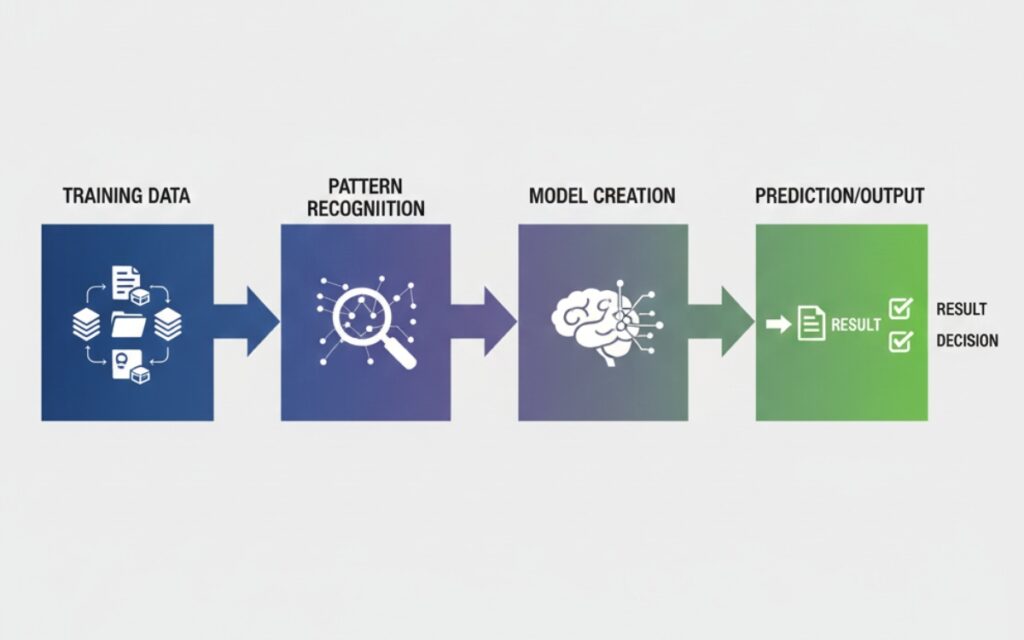
Here’s what happens in most AI systems:
- Training: You feed the AI tons of examples (data)
- Pattern Recognition: The AI finds patterns in that data
- Model Creation: It builds a mathematical model of those patterns
- Prediction: When you give it new data, it uses that model to make predictions
Last month, I trained a simple sentiment analyzer on customer reviews. I showed it 10,000 reviews labeled “positive” or “negative.” The AI learned patterns like “great” and “love” usually mean positive, while “terrible” and “broken” usually mean negative.
Was it perfect? Hell no. It thought “not bad” was negative because of the word “bad.” But it was right 85% of the time, which beat our previous keyword-based system by a mile.
Key AI Concepts That Matter
Machine Learning
This is the subset of AI where systems learn from data. Most modern AI is actually machine learning. You’ll hear people use them interchangeably, and honestly, that’s fine for casual conversation.
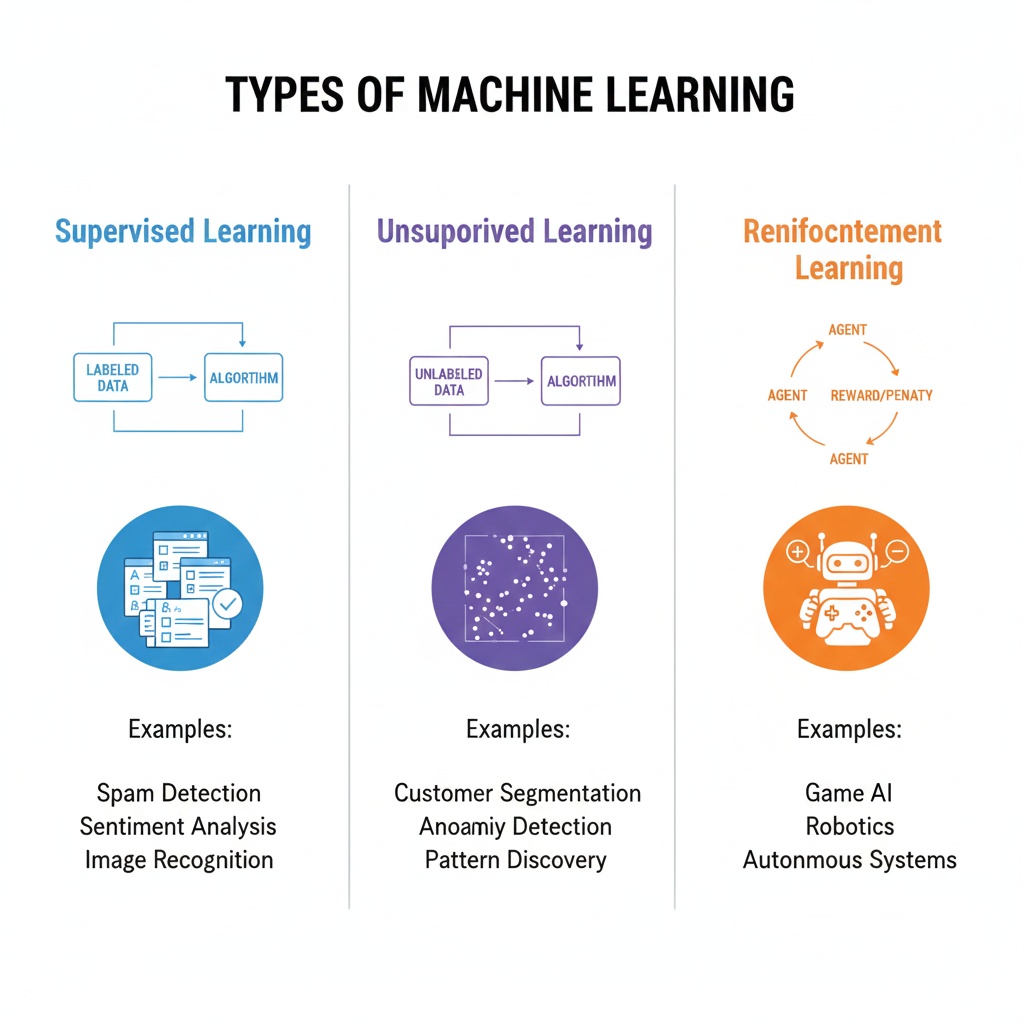
There are three main types:
- Supervised Learning: You give labeled examples (like my sentiment analyzer)
- Unsupervised Learning: The AI finds patterns without labels
- Reinforcement Learning: The AI learns by trial and error (think game-playing bots)
Neural Networks
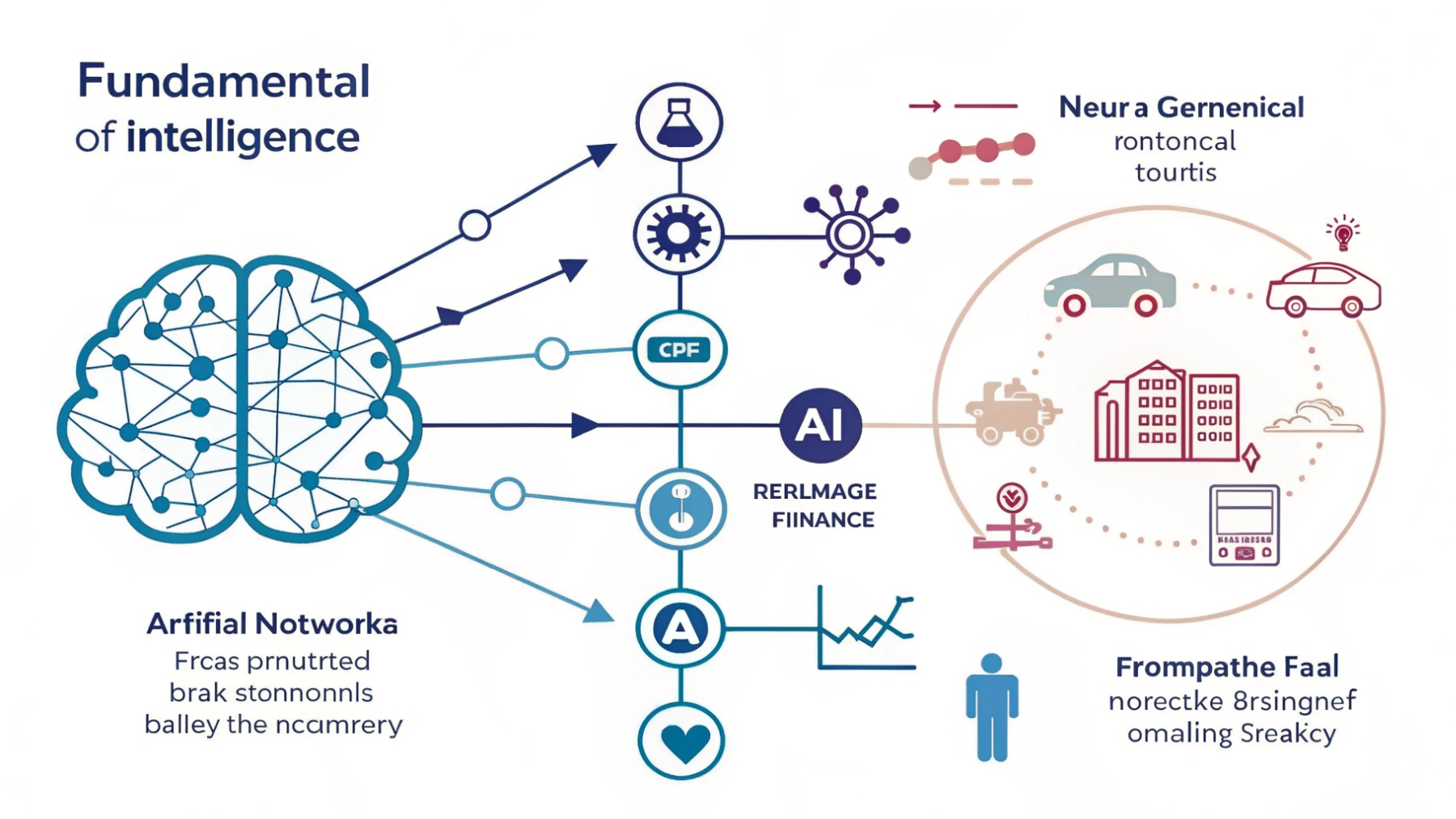
These are inspired by how our brains work, with interconnected nodes that process information. Don’t get too attached to the brain metaphor though. Real brains are way more complex and we barely understand them.
I’ve built a couple basic neural networks using TensorFlow. They’re incredibly powerful but also incredibly finicky. Change one parameter and your accuracy drops by 20%. Fun times.
Deep Learning
This is just neural networks with many layers. “Deep” refers to all those layers, not some philosophical depth. Deep learning is what powers most of the impressive AI you see today: image recognition, language models, voice assistants.
The downside? Deep learning needs massive amounts of data and computing power. I tried training a deep learning model on my laptop once. It ran for 18 hours and my laptop sounded like it was going to achieve liftoff.
Why AI Matters Now
Here’s what changed in the last decade: AI moved from research labs to production systems.
Industries using AI today:
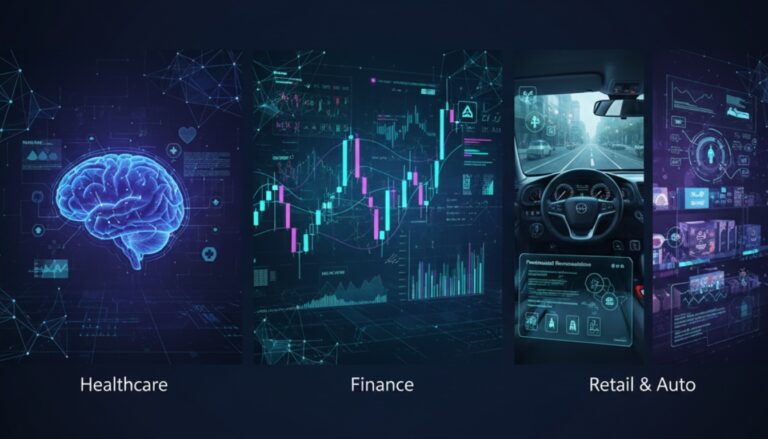
- Healthcare: Diagnosing diseases from medical images
- Finance: Detecting fraud, algorithmic trading
- Retail: Inventory prediction, dynamic pricing
- Transportation: Self-driving cars, route optimization
- Manufacturing: Quality control, predictive maintenance
I’ve seen companies cut customer service costs by 40% with AI chatbots. I’ve also seen those same chatbots give hilariously wrong answers because they weren’t trained properly. It’s a tool, not magic.
The reason AI is taking off now isn’t just better technology. It’s that the infrastructure finally exists: cloud computing, APIs, pre-trained models you can customize. You don’t need a PhD anymore to implement basic AI features.
Common AI Misconceptions
Let me clear up some things that drove me crazy when I was learning:
“AI will take all our jobs” – Some jobs, sure. But AI also creates new ones. Someone needs to train these models, maintain them, and clean the data. Data scientist wasn’t even a job title 15 years ago.
“AI is objective” – Nope. AI learns from data, and if that data has biases, the AI inherits them. I’ve seen hiring algorithms reject qualified candidates because the training data reflected historical discrimination.
“AI understands what it’s doing” – Not really. Current AI is pattern matching on steroids. It doesn’t “understand” images or language the way humans do. It just finds statistical correlations.
“You need to be a math genius” – For research? Maybe. For using AI tools? Not at all. I use AI APIs all the time without touching the underlying math.
Getting Started with AI
If you’re curious about AI, here’s what I’d actually recommend:
Start small. Play with existing AI tools before building your own. Try GPT models, experiment with image generators, use ML APIs from Google or AWS. See what they can and can’t do.
When you’re ready to build something, Python is your friend. TensorFlow and PyTorch are the big frameworks. Scikit-learn is great for simpler projects.
But honestly? The best way to learn is to solve a real problem. I learned more building that terrible recommendation engine than from watching hours of tutorials.
Where to Go from Here
This is just scratching the surface. AI is a massive field with rabbit holes everywhere. The good news? You don’t need to master it all.
Pick what interests you. Maybe it’s natural language processing if you’re into text analysis. Or computer vision if images are your thing. There’s also machine learning basics if you want to dig deeper into the algorithms.
For a broader understanding of where AI fits in the bigger picture, check out our complete guide on Artificial Intelligence and Machine Learning. And if you’re curious about what’s coming next, the future of artificial intelligence explores where this tech is heading.
The Bottom Line
AI isn’t as scary or as magical as people make it out to be. It’s a powerful tool that’s really good at specific tasks when you have enough data and computing power.
Will it change everything? Parts of everything, probably. Should you learn about it? Yeah, especially if you’re in tech. But you don’t need to panic about robot overlords or rush to become a data scientist overnight.
Start with the basics, play around, break things, and learn from what goes wrong. That’s how I figured it out, and I’m betting it’ll work for you too.
Now go build something. Or at least try to. The first attempt probably won’t work, but that’s kind of the point.
This article is part of our comprehensive guide on Artificial Intelligence and Machine Learning. For more in-depth coverage of AI topics, explore our complete resource hub.