Types of Artificial Intelligence: From Narrow AI to AGI (And Everything Between)
Look, when most people hear “artificial intelligence,” they picture robots taking over the world or some sci-fi nightmare. I get it. But here’s the thing: the AI you interact with every day is about as close to Skynet as your toaster is to running Doom.
I’ve been working with AI systems for about five years now, and the disconnect between what people think AI is versus what it actually does still surprises me. So let’s clear this up. There are different types of AI, and understanding which is which matters if you’re building with it, investing in it, or just trying to figure out what all the hype is about.
This article is part of our comprehensive guide on Artificial Intelligence and Machine Learning. For the full guide covering everything from basics to advanced applications, check out the main resource.
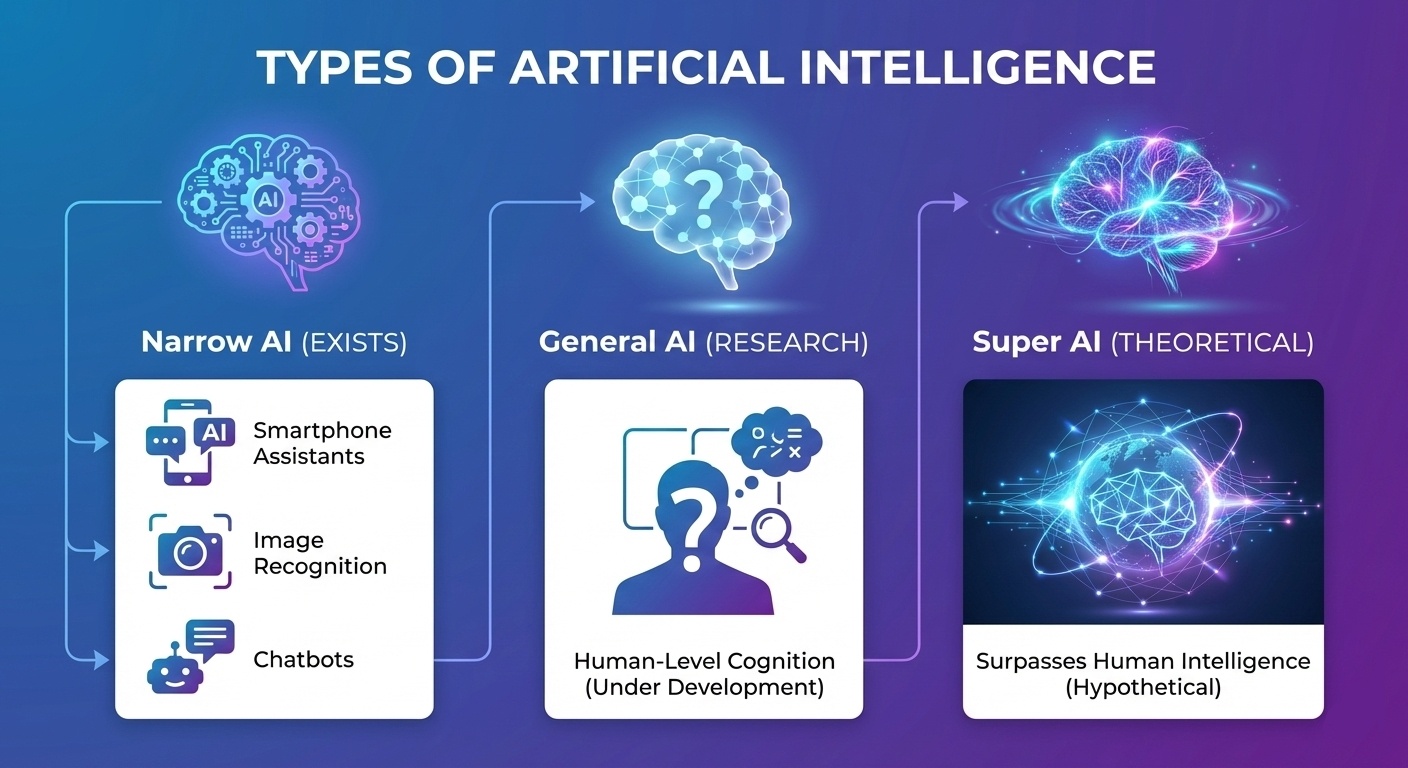
The Three Main Categories Everyone Talks About
When AI researchers classify artificial intelligence, they typically break it down into three broad categories based on capability. But here’s what you need to know: only one of these actually exists right now.
Narrow AI (ANI): The Only Real AI We Have

Narrow AI, also called Artificial Narrow Intelligence or Weak AI, is basically AI that’s really good at one specific task. And when I say really good, I mean superhuman level good. But only at that one thing.
Every AI system you’ve actually used is Narrow AI:
- The recommendation algorithm on Netflix that knows you’ll probably watch another true crime doc
- The spam filter in your Gmail (which honestly still lets through some garbage)
- The voice assistant that can tell you the weather but gets confused if you ask it anything philosophical
- That chess engine that’ll destroy you in 12 moves
I worked on a chatbot project last year that used narrow AI for customer service. It was incredible at answering FAQs about shipping times and return policies. But ask it anything slightly off-script? Total confusion. That’s narrow AI in a nutshell.
Real-World Applications of Narrow AI
Here’s where narrow AI actually shines:
Image Recognition: I’ve built systems using computer vision APIs that can identify objects in photos with scary accuracy. They can tell you if there’s a cat in an image, what breed it probably is, and whether it looks angry. But ask that same system to understand why the cat is angry? Nothing.
Language Translation: Tools like DeepL and Google Translate are narrow AI. They’re phenomenal at converting text from one language to another. I use them constantly when reading research papers in languages I don’t speak. But they don’t actually “understand” the text.
Predictive Analytics: Every time you see “customers who bought this also bought…” that’s narrow AI analyzing patterns. It works because it’s focused on one task: finding correlations in purchase behavior.
The thing about narrow AI is that it’s incredibly useful and incredibly limited at the same time. You can’t just take a narrow AI trained to recognize faces and expect it to suddenly start writing poetry. Doesn’t work that way.
For more on how these systems actually learn and improve, check out our guide on Machine Learning Basics.
General AI (AGI): The Holy Grail We Don’t Have
Artificial General Intelligence is the stuff of science fiction. This is AI that can understand, learn, and apply knowledge across multiple domains just like a human can. It could write code, diagnose diseases, compose music, and have a philosophical debate, all without being specifically programmed for each task.
Here’s the brutal truth: AGI doesn’t exist. Not even close.
I’ve sat through so many startup pitches claiming they’re “building AGI” or that their product is “one step away from general intelligence.” It’s nonsense. We’re not even sure how to build it. The human brain is insanely complex, and we still don’t fully understand how our own intelligence works.
Some researchers think we might see AGI in 20 years. Others say 100 years. Some say never. I’m in the “we’ll see, but not holding my breath” camp.
Why AGI is Hard: The problem isn’t just technical. It’s philosophical. What even is general intelligence? How do we measure it? Can a system that processes information fundamentally differently than humans really be considered “generally intelligent”?
I spent time reading research papers on consciousness and intelligence (big mistake at 2 AM), and the more you dig in, the more you realize how much we don’t know.
If you’re interested in the ethical implications of potentially developing AGI, our article on Ethical Issues in AI covers some fascinating debates.
Super AI (ASI): The Sci-Fi Scenario
Artificial Super Intelligence is AI that surpasses human intelligence in every way. Not just at chess or image recognition, but at creativity, emotional intelligence, problem-solving, everything.
This is the type of AI that keeps philosophers and futurists up at night. It’s also purely theoretical. We don’t have AGI yet, so ASI is even further off.
Some people worry about ASI becoming dangerous (the whole “paperclip maximizer” thought experiment). Others think it could solve all our problems. Me? I think we’ve got more immediate concerns with the AI we actually have.
Alternative Ways to Think About AI Types
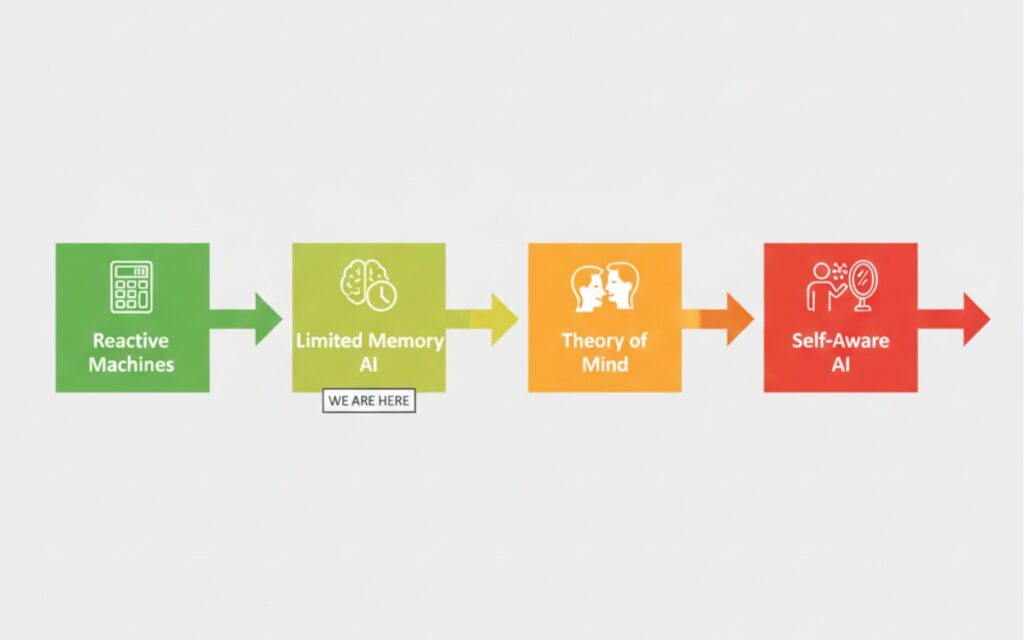
The Narrow/General/Super framework is clean, but there are other useful ways to categorize AI systems based on how they work rather than how smart they are.
Reactive Machines
These are AI systems with no memory. They respond to current inputs without any concept of past or future. IBM’s Deep Blue, the chess computer that beat Garry Kasparov, was a reactive machine.
It evaluated the current board position and calculated possible moves, but it didn’t “remember” previous games or learn from experience. Each game was brand new.
You still see reactive AI in some game-playing systems and basic decision-making algorithms.
Limited Memory AI
This is what most modern AI systems are. They can use past experiences to inform current decisions. Your smartphone’s predictive text learns from what you type. Self-driving cars use sensor data from the past few seconds to make driving decisions.
I worked with a fraud detection system that was limited memory AI. It analyzed patterns in transaction history to flag suspicious activity. The more data it processed, the better it got at spotting fraud.
Most of the AI covered in our article on AI Algorithms You Should Know falls into this category.
Theory of Mind AI (Doesn’t Exist Yet)
This would be AI that understands emotions, beliefs, and thoughts. It could predict how humans might feel or react in different situations.
We’re nowhere near this. Some research labs are working on it, especially for better human-robot interaction, but it’s still theoretical.
Self-Aware AI (Also Doesn’t Exist)
This would be AI with consciousness and self-awareness. It’s the stuff of philosophy debates and sci-fi novels. I’m not holding my breath on this one.
Why the Type of AI Matters (Real Talk)
When someone tells you they’re using “AI” in their product, your first question should be: what kind?
If it’s a narrow AI doing recommendation, that’s proven technology. If they’re claiming some breakthrough toward AGI, you should be skeptical. Very skeptical.
I reviewed a startup pitch last month where they claimed their chatbot had “human-like understanding.” I tested it. It was a fine narrow AI trained on a specific domain, but human-like? Not even close. It failed basic tests that any six-year-old would pass.
For developers and businesses: Understanding AI types helps you set realistic expectations. You can build amazing things with narrow AI. But you can’t build everything, and you need to be honest about limitations.
For users: When AI makes mistakes (and it will), understanding what type of AI you’re dealing with helps you know what to expect and what to forgive.
The Current State of Things
Right now, all commercial AI is narrow AI. Every product, every service, every app using “AI” is using some form of narrow intelligence.
And that’s okay! Narrow AI is incredibly powerful. It’s transforming industries from healthcare to finance to marketing.
The problems start when companies oversell what their AI can do. Or when people expect general intelligence from systems that are fundamentally narrow.
I’ve debugged enough AI implementations to know that most “AI failures” aren’t really failures. They’re just narrow AI systems being used outside their domain. It’s like being mad at a hammer for not being a screwdriver.
What This Means Going Forward
The field is moving fast. Models are getting better, more general-purpose, and more capable. GPT-4 and similar large language models can handle way more tasks than previous narrow AI, but they’re still not AGI. They’re just really good narrow AI with a broader domain.
For more on where things are headed, check out our piece on the Future of Artificial Intelligence.
If you’re learning to work with AI systems, start with understanding their limitations. Learn what they’re good at, what they suck at, and when to use them versus when to stick with traditional programming. Our AI Tools for Beginners guide is a solid starting point.
Bottom Line
We have narrow AI. We don’t have general AI. We definitely don’t have super AI.
Every AI you use today is specialized. It’s really good at specific tasks and useless at everything else. That’s not a bug, it’s just the current state of technology.
Understanding this distinction keeps you from getting caught up in hype or disappointment. It also helps you make better decisions about when and how to use AI in your own projects.
And honestly? Narrow AI is already changing the world. We don’t need AGI to revolutionize industries. We just need to get better at deploying the AI we already have.
For a deeper dive into how all this fits together, head back to our main Artificial Intelligence and Machine Learning guide where we cover everything from the fundamentals to cutting-edge applications.