AI in Healthcare: Real Talk About What’s Actually Working (And What Isn’t)
I’ll be honest. When I first heard about AI diagnosing diseases better than doctors, I rolled my eyes. Hard. It sounded like the same hype cycle we’ve seen with blockchain, metaverse, and every other buzzword that was supposed to “revolutionize everything.”
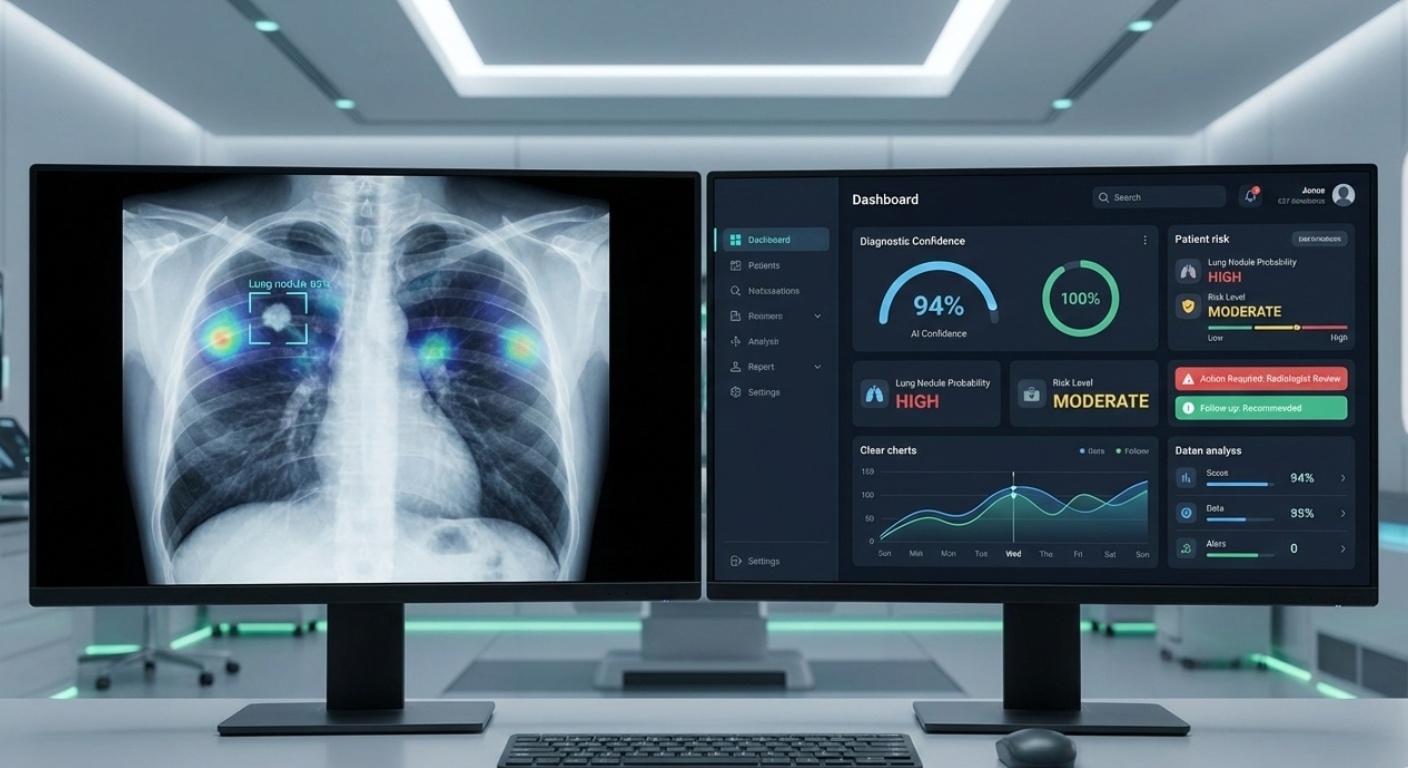
Then my sister, who’s an ER nurse, showed me this radiology AI tool her hospital started using last year. It flagged a tiny lung nodule that three radiologists had missed on initial scans. Patient caught it early. Different outcome entirely.
So yeah, I’m a convert. But not blindly. Let’s talk about what AI is actually doing in healthcare right now, where it’s genuinely useful, and where it’s still got a long way to go.
This article is part of our comprehensive guide on Artificial Intelligence and Machine Learning. For the full guide, check out the main resource.
The Reality Check: What AI in Healthcare Actually Looks Like
Forget the sci-fi stuff for a second. Most AI in healthcare right now isn’t some sentient robot performing surgery. It’s more mundane than that, but way more useful.
Here’s what’s actually deployed and working:
Medical imaging analysis. This is where AI genuinely shines. Tools like Aidoc and Zebra Medical Vision scan CT scans, X-rays, and MRIs faster than humanly possible. They’re not replacing radiologists. They’re flagging potential issues so radiologists can focus on the tricky cases.
My sister’s hospital uses an AI system for detecting intracranial hemorrhages. It cuts the time to diagnosis from hours to minutes. In stroke cases? That’s literally life or death.
Predictive analytics for patient risk. Hospitals are using predictive analytics to identify patients who might crash before they crash. The system ingests vitals, lab results, medical history, and spits out risk scores.
One study at Johns Hopkins showed their AI predicted sepsis onset six hours earlier than traditional methods. Six hours is huge when you’re talking about sepsis mortality rates.
Drug discovery acceleration. This one’s less visible but potentially massive. AI models are screening millions of molecular compounds to find potential drug candidates. What used to take years now takes months.
Insilico Medicine used AI to identify a drug candidate for pulmonary fibrosis in 18 months. Traditional methods? Five years, easy.
The Diagnosis Game: Where Computer Vision Meets Medicine
Let’s get specific about computer vision in healthcare. Because this is where things get really interesting and also really complicated.
Diabetic retinopathy screening is probably the most successful deployment. Google’s AI can detect diabetic eye disease from retinal scans with 90%+ accuracy. India’s using this at scale because they don’t have enough ophthalmologists. The AI does the initial screening, flags the serious cases, and ophthalmologists handle those.
Smart, right? That’s the model that works: AI as triage, humans as decision makers.
Skin cancer detection is another area where AI performs well in controlled settings. Tools like SkinVision analyze photos and flag suspicious moles. But here’s the catch I found out the hard way: lighting matters. Phone camera quality matters. The angle matters.
I tested one of these apps last year after finding a weird spot on my arm. The app said “low risk.” Dermatologist said “yeah, we should remove that just to be safe.” It was benign, but the point stands. AI in the wild is different from AI in the lab.
Pathology and tissue analysis is probably where I’m most excited. PathAI and Paige.AI are helping pathologists analyze tissue samples for cancer detection. They’re catching things that are easy to miss when you’re staring at slides for 10 hours straight.
But nobody’s trusting the AI alone. It’s always: AI suggests, pathologist confirms.
The Treatment Planning Side: Personalized Medicine Gets Real
This is where AI starts feeling like actual science fiction, but it’s happening now.
Cancer treatment recommendations are being augmented by AI systems that analyze your specific tumor genetics, compare against thousands of similar cases, and suggest treatment protocols. IBM’s Watson for Oncology tried this and… well, it had mixed results. Turned out it was trained mostly on hypothetical cases, not real patient outcomes.
Lesson learned: AI is only as good as its training data. And in healthcare, real-world messy data beats clean theoretical data every time.
Radiation therapy planning is where AI really delivers. It can calculate optimal radiation beam angles and doses way faster than manual planning. Varian’s AI does this in minutes instead of hours. And we’re talking about highly complex 3D calculations here.
Medication management is another practical win. AI systems flag potential drug interactions, suggest dosage adjustments based on patient factors, and predict adverse reactions. Not sexy, but it prevents a lot of medical errors.
There’s an AI tool called MedAware that caught a pharmacist about to dispense a 10x overdose of a blood thinner. System flagged it as statistically anomalous. Crisis averted.
The Data Problem Nobody Wants to Talk About
Here’s where I get a bit cynical. Because AI in healthcare has some serious problems that don’t make it into the marketing materials.
Data quality is all over the place. Electronic health records are a mess. Different formats, missing data, inconsistent labeling. I talked to a data scientist working on a hospital AI project who told me they spend 80% of their time just cleaning data. Sound familiar to anyone who’s done machine learning work?
Bias is built in. If your AI is trained mostly on data from white male patients (which a lot of them are, historically), it’s going to perform worse on women and minorities. There’s documented cases of pulse oximeters and diagnostic tools being less accurate for darker skin tones.
This isn’t theoretical. People get misdiagnosed because of this stuff.
Interoperability doesn’t exist. Hospital A’s AI can’t talk to Hospital B’s system. Hell, sometimes different departments in the same hospital can’t share data properly. It’s 2024 and we’re still faxing medical records in many places.
Regulatory approval takes forever. Getting FDA clearance for a medical AI tool is not quick. By the time it’s approved, the underlying models might be outdated. And unlike software where you can just push updates, medical devices have to go through re-approval for significant changes.
Privacy and Ethics: It Gets Complicated Fast
Look, I’m generally pretty pragmatic about privacy tradeoffs. But healthcare data is different. Once your genetic information or medical history gets out, you can’t change it like you’d change a password.
HIPAA compliance is just the starting point. Cloud-based AI tools processing patient data need serious security. There’s been cases where researchers “anonymized” patient data, but people got re-identified anyway using auxiliary information.
Consent is tricky. Did patients consent to their health records being used to train AI models? Usually the answer is “sort of” or “it’s in the fine print.” That doesn’t sit right with me.
The black box problem is real in healthcare. When an AI recommends a treatment, can the doctor explain why? If not, that’s legally and ethically messy. This is why explainable AI is such a big focus in medical applications.
There’s also the ethical issues around AI in terms of access. If an AI tool dramatically improves outcomes but costs $500,000 per hospital, who gets access? Rich hospital systems, that’s who.
What Actually Works: The Pattern I’m Seeing
After researching this for weeks and talking to people actually deploying this stuff, here’s the pattern that seems to work:
- AI augments, doesn’t replace. The successful deployments all have a human in the loop. AI flags, doctors decide.
- Start with high-volume, repetitive tasks. Image analysis, data entry, scheduling. Let AI handle the grunt work.
- Focus on time-critical applications. Stroke detection, sepsis prediction, emergency triage. Where minutes matter, AI’s speed is valuable.
- Don’t trust it blindly. Even 95% accuracy means 1 in 20 is wrong. In healthcare, that’s not acceptable for final decisions.
- Keep it narrow. The AI tools that work well do one thing really well. The ones that try to be general-purpose diagnostic systems? They struggle.
The Real-World Deployment Challenges
Hospitals aren’t tech companies. They can’t just spin up a Kubernetes cluster and deploy the latest model. (Though if you’re curious about that world, check out our AI tools guide).
Integration with existing systems is a nightmare. Legacy hospital IT systems are ancient. Getting a modern AI tool to play nice with a 20-year-old patient management system? Good luck.
Training staff takes time. Nurses and doctors are already overworked. Adding a new AI tool to their workflow needs to actually make their lives easier, not harder.
Cost justification is tough. Hospital administrators need to see ROI. An AI tool that improves outcomes by 5% might be worth millions in value, but if it costs millions to implement, the business case gets fuzzy.
Where This Is All Heading
In the next few years, I think we’ll see AI become standard in a few key areas:
Administrative automation will be huge. AI handling appointment scheduling, insurance pre-approvals, medical coding. The boring stuff that takes up half of healthcare workers’ time.
Remote patient monitoring combined with AI will probably explode, especially post-pandemic. Wearables feeding data to AI models that alert doctors when something’s off.
Genomic medicine is going to get wild. AI analyzing your DNA to predict disease risk and customize treatments. We’re just scratching the surface here.
But here’s what I don’t think will happen soon: fully automated diagnosis without human oversight. The liability issues alone make that a non-starter. And honestly? That’s probably good.
The Bottom Line
AI in healthcare isn’t hype anymore. It’s real, it’s deployed, and it’s saving lives. But it’s not magic, and it’s not replacing doctors anytime soon.
The wins are in augmentation, speed, and handling tasks that are impossible at human scale. The losses are in bias, data quality, and the complexity of real-world deployment.
If you’re working in healthcare tech or thinking about it, focus on specific, measurable problems. Don’t try to build the general-purpose medical AI. Pick one thing, do it really well, and make sure there’s a clear path to clinical validation.
And for the love of god, work with actual clinicians from day one. The number of health tech projects I’ve seen fail because engineers built what they thought doctors needed instead of what doctors actually needed is just… it’s painful.
Want to dive deeper into how AI makes predictions? Check out our guide on predictive analytics with AI. Or if you’re interested in the broader financial impact of AI, our article on AI in finance covers similar territory.
The future of healthcare is definitely AI-assisted. But it’s going to be messier, slower, and more human than the hype suggests. And that’s okay.