AI Startups to Watch: Companies Actually Building the Future (Not Just Talking About It)
I’ve been tracking AI startups for three years now. You know what I’ve learned? For every company genuinely solving hard problems, there are ten slapping “AI-powered” on their landing page and calling it innovation.
But here’s the thing. Some startups are actually doing interesting work. Not the ones getting splashy TechCrunch coverage for their Series A (though sometimes those too). I’m talking about companies building tools I’d actually use, solving problems that kept me up at 2 AM during production incidents.
This article is part of our comprehensive guide on Artificial Intelligence and Machine Learning. If you want the full picture of where AI is heading, start there.
Why I Started Paying Attention to AI Startups
Last year, I was debugging a data pipeline that kept failing. The error logs were useless. Thousands of lines of stack traces that basically said “something broke somewhere.” I spent four hours tracing through code before finding the issue.
Two months later, I tried a new AI-powered debugging tool from a startup I’d never heard of. It found the same type of issue in 90 seconds. That’s when I realized: the practical AI applications aren’t coming from the usual suspects. They’re coming from companies most people haven’t heard of yet.
So I started keeping a list. Not comprehensive. Not ranked. Just companies doing things that made me think “huh, that’s actually useful.”
The Infrastructure Layer: Making AI Possible

Modal Labs
These folks are building something I wish existed two years ago when I was wrestling with GPU infrastructure for a machine learning project. They let you run code on GPUs without managing servers. Sounds simple, but if you’ve ever tried to set up a GPU cluster on AWS, you know it’s anything but.
I tested their platform last month. Deployed a model inference endpoint in about 15 minutes. Compare that to the three days I spent configuring Kubernetes with GPU support at my last job. Yeah.
What makes them interesting: They’re focused on developer experience. Their Python SDK actually makes sense. Novel concept, I know.
Weights & Biases
ML experiment tracking. Before tools like this existed, we were logging metrics to text files and creating Excel charts like animals. W&B (as everyone calls them) isn’t new anymore, but they’re still innovating faster than the competition.
They’ve added features for AI model monitoring and dataset versioning that I wish I’d had during my last model training disaster. You know that feeling when you can’t reproduce your best model run because you forgot which dataset version you used? They solved that.
The Application Layer: Where Things Get Interesting
Anthropic
Full disclosure: I’m writing this in 2024, so Anthropic isn’t exactly a “startup” anymore. But they’re building Claude, which I use daily for code reviews. Not because it’s perfect (it’s not), but because it catches things I miss when I’m tired.
Their focus on AI safety isn’t just PR talk. They publish actual research on interpretability and alignment. As someone who’s seen production ML models do weird unexpected things, I appreciate a company that thinks about failure modes.
Related: If you’re curious about the ethics side of this, check out our article on Ethical Issues in AI.
Cursor
This one’s for the developers. Cursor is an AI-powered code editor that’s actually good. I was skeptical. I’ve tried a dozen “AI coding assistants” that were basically fancy autocomplete with marketing budgets.
Cursor is different. It understands context across your entire codebase. Ask it to refactor a function, and it’ll update all the call sites too. It’s like having a junior developer who never gets tired and actually reads the documentation.
I switched to it three months ago. Still using it. That’s my review.
Perplexity AI
Search, but actually useful. Google’s been declining for years (SEO spam, ads, garbage content farms). Perplexity takes your question, searches multiple sources, and gives you an actual answer with citations.
I use it constantly for AI research and technical questions. It’s not perfect. Sometimes the sources are questionable. But it beats clicking through ten ad-filled blog posts to find one useful paragraph.
The Vertical-Specific Players
Harvey AI (Legal)
Legal research powered by AI. I don’t practice law (thank god), but I have lawyer friends who’ve shown me this. It can analyze contracts, find relevant case law, and draft legal documents.
What’s impressive isn’t just the tech. It’s that they trained models specifically for legal work. General-purpose AI models are terrible at legal reasoning because they weren’t built for it. Harvey focused on one vertical and actually solved real problems.
Mendel AI (Healthcare)
Healthcare data is a nightmare. Different formats, privacy regulations, legacy systems that predate the internet. Mendel built AI tools specifically for clinical trial data and medical research.
I learned about them through a friend working in AI in healthcare. Apparently, they’re solving problems that pharmaceutical companies have been throwing money at for years. That’s the kind of startup that interests me. Finding expensive manual processes and automating them.
Hebbia (Finance)
Document analysis for financial firms. Banks, investment firms, and hedge funds process millions of documents. Hebbia’s AI can extract insights from financial reports, earnings calls, SEC filings, all that fun stuff.
The AI in finance space is crowded, but Hebbia’s approach is interesting. They focus on retrieval and synthesis, not just extraction. So you can ask “what did these five companies say about supply chain issues?” and get a coherent answer.
The Dark Horses
Character AI
I almost didn’t include this one because it sounds gimmicky. AI chatbots that roleplay as fictional characters. But the technology behind it is legitimately impressive. They’ve figured out how to make language models maintain consistent personalities over long conversations.
Why does this matter? Because the same tech applies to customer service, virtual assistants, and personalized education. The gaming application is just the wedge.
Runway ML
Video generation and editing with AI. I tested their tools for a project last month. You can remove objects from videos, change backgrounds, even generate short clips from text descriptions. It’s early and imperfect, but the direction is clear.
What I like: they’re building tools for creators, not just researchers. Practical applications, not just demos.
Adept AI
They’re trying to build AI that can use software tools for you. Tell it “book me a flight to Seattle next Tuesday under $300” and it’ll actually navigate websites and complete the task.
Ambitious? Yes. Likely to work? Maybe. Worth watching? Absolutely. If they pull this off, it changes everything about how we interact with computers.
The Reality Check
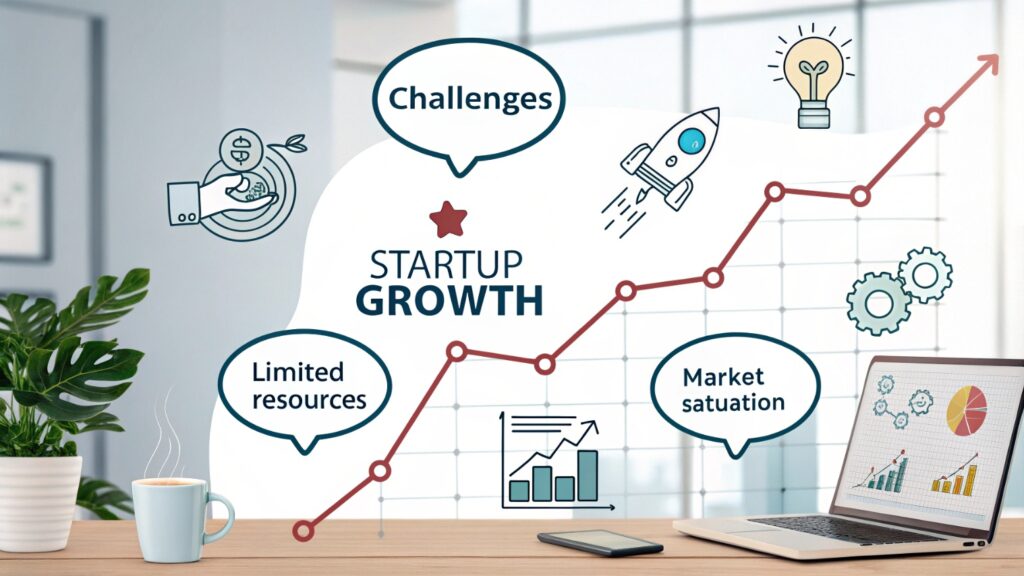
Here’s what nobody tells you about AI startups: most will fail. Not because the tech is bad, but because building a sustainable business around AI is hard.
Some problems:
- Costs are brutal. Training and running models is expensive. Most startups can’t afford it long-term without massive funding.
- Commoditization is real. Today’s breakthrough is next year’s open-source library.
- Distribution matters more than tech. The best AI won’t win if nobody uses it.
I’ve watched promising startups shut down because they couldn’t figure out monetization. Or because OpenAI released a feature that did 80% of what they did, for free.
But the ones that survive? They’re building the infrastructure we’ll all use in five years.
What to Look For in AI Startups
After tracking dozens of companies, I’ve noticed patterns in the ones that seem to have staying power:
They solve specific problems. Not “AI for everything.” More like “AI for detecting manufacturing defects in automotive parts.” Narrow focus, deep expertise.
They have distribution figured out. Either they’re selling to enterprises with real budgets, or they’ve built something consumers actually want (rare).
They’re not just wrapping OpenAI’s API. Fine for a side project. Not a defensible business. The interesting startups have proprietary models, unique data, or both.
They talk about their failures. Companies that only share success stories are hiding something. The good ones are honest about what doesn’t work yet.
Where This Is All Going
I think we’re in the “iPhone moment” for AI startups. Remember 2008-2010 when everyone was building apps because suddenly you could? We’re there now with AI.
Most of these companies won’t exist in five years. But the ones that survive will be huge. And some of the best ideas are probably being built right now in someone’s garage by a team we’ve never heard of.
That’s why I keep watching. Not because I think I can predict winners (I can’t). But because it’s fascinating to see what people build when they’re given new tools.
If you want to understand the broader context of where AI is headed, our article on the Future of Artificial Intelligence covers the big trends. And if you’re thinking about building your own AI startup, start with AI Tools for Beginners to understand what’s already out there.
Should You Use Products from These Startups?
Real talk: it depends on your risk tolerance.
Early-stage startups might shut down. Their APIs might break. They might get acquired and the product you love gets killed. I’ve been burned by this before. Twice.
But if you’re okay with that risk? Some of these tools are genuinely better than alternatives from established companies. Innovation happens at the edges, not in the middle.
I use products from about six AI startups regularly. I keep alternatives ready just in case. That’s my strategy. Use the best tool available, but don’t build your entire workflow around a company that might not exist next year.
The Bottom Line
The AI startup landscape is messy, overhyped, and full of nonsense. It’s also where the most interesting work in tech is happening right now.
I can’t tell you which companies will win. But I can tell you this: the future of AI won’t be built entirely by Google, Microsoft, and OpenAI. Some of it will come from companies most people haven’t heard of yet.
That’s worth paying attention to.
For a deeper dive into how these startups are tackling specific challenges, check out our guides on AI in cybersecurity, generative AI, and AI algorithms.