
Startup Tech Funding News: The Reality Behind the Headlines
So you’ve been reading TechCrunch headlines about some startup raising $50 million, and you’re wondering what that actually means. Or maybe you’re building something yourself and trying to figure out if venture capital is even worth chasing.
I’ve watched the startup funding game from the sidelines for years now, talked to founders who’ve raised millions, and seen plenty of others crash and burn trying. Here’s what I’ve learned: the funding news you read is usually about 30% of the actual story.
Let me break down what’s really happening in the startup funding world right now.
What “Startup Funding” Actually Means
When you see a headline like “XYZ raises $25M Series B,” that’s not just free money landing in a bank account. There’s usually a complicated cap table situation, liquidation preferences, and board seats changing hands. The founder might have just sold a big chunk of their company for cash they can’t touch personally.
I talked to a friend last year who raised a $10M Series A. Sounds amazing, right? Except the VCs got 2x liquidation preference, anti-dilution protection, and three board seats. If the company sells for less than $50M, he basically gets nothing after everyone else is paid.
Nobody mentions this stuff in the press releases.
The Current Funding Climate (Real Talk)
Here’s where things stand as of late 2024 going into 2025: it’s weird out there.
After the 2021-2022 funding frenzy where people were throwing money at anything with “AI” in the pitch deck, we hit a hard correction in 2023. Now? It’s cautiously optimistic but way more selective. VCs are actually asking about revenue now. Wild concept, I know.
What I’m seeing funded:
- AI infrastructure tools (but only if you have actual customers)
- Developer tools with measurable productivity gains
- Vertical SaaS with proven unit economics
- Climate tech that’s past the science experiment phase
What’s struggling:
- Consumer apps without clear monetization
- “Uber for X” plays (we’re past that)
- Anything that needs 50 million users before it makes money
- Web3 stuff unless you have serious traction
The bar’s just higher now. Which honestly isn’t a bad thing.
How to Actually Track Funding News
If you want to stay on top of startup funding, here’s what actually works:
Crunchbase is still the gold standard. Yeah, it’s not free anymore for the good stuff, but if you’re serious about tracking this space, the $29/month Pro plan is worth it. You can set alerts for specific sectors, funding stages, or investor activity.
PitchBook is what the pros use, but unless your company is paying for it, you’re not getting in. It’s expensive.
For free options, TechCrunch’s funding roundup posts are decent. They miss stuff, but they catch the big rounds. I check it Monday mornings with my coffee.
Twitter (sorry, “X”) is surprisingly useful if you follow the right VCs and founders. You’ll often hear about rounds before the official announcements. Just filter out the noise and self-promotion.
Recent Funding Trends Worth Knowing
AI is still hot, but different now. In 2023, people were funding AI ideas. Now they’re funding AI businesses with actual metrics. I saw a dev tools startup raise $15M last month with only 8 months of revenue history, but they had impressive growth numbers and enterprise contracts.
Climate tech is having a moment. Real money is flowing into carbon capture, sustainable materials, and energy storage. Not the “let’s save the world” projects from 2019, but stuff with actual business models and government contracts.
B2B SaaS is back to basics. Show me your CAC, LTV, and churn rate. If those numbers work, you can raise money. If they don’t, good luck. The “growth at all costs” era is dead.
Down rounds are happening. Companies that raised at crazy valuations in 2021 are coming back down to earth. Saw three unicorns take down rounds this year. It’s not always bad, sometimes it’s just reality catching up.

What Those Funding Terms Actually Mean
When you see funding news, here’s the quick translation:
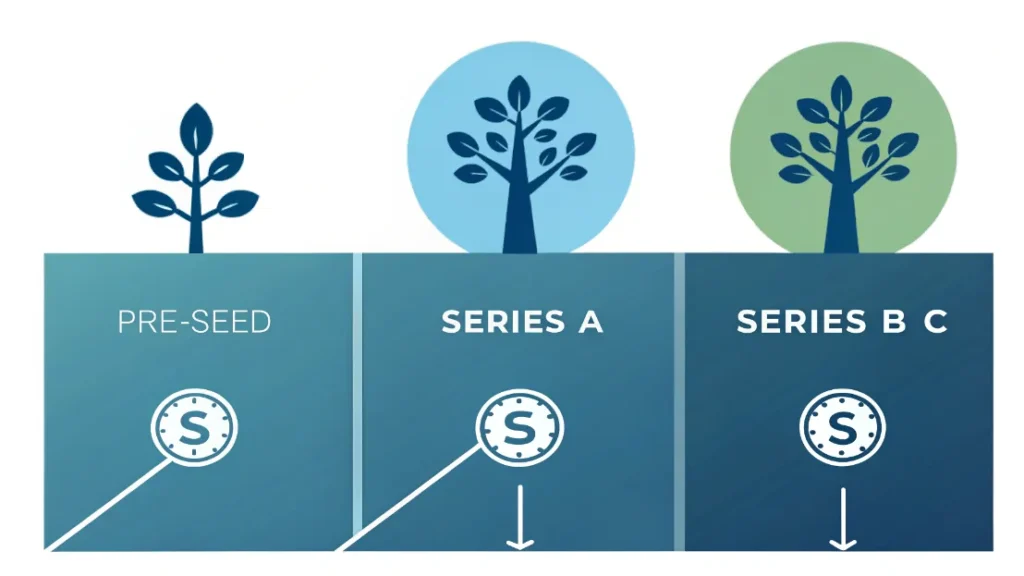
Pre-seed: Usually $500K-$2M. You’ve got an idea and maybe a prototype. High risk, high dilution.
Seed: $2M-$5M range. You need some traction now. Real users, some revenue, or crazy impressive metrics.
Series A: $5M-$15M typically. This is where it gets serious. You need proven product-market fit and a clear path to scale.
Series B and beyond: You’re scaling now. Need strong unit economics and a plan for profitability (yes, that’s back in fashion).
The alphabet soup (A, B, C, etc.) just indicates how many times you’ve raised institutional money. It’s not a achievement ladder, it’s dilution stages.
Red Flags in Funding Announcements
After reading hundreds of funding announcements, some patterns jump out:
If a company won’t disclose the amount raised, that’s often a sign it’s smaller than you’d expect or came with rough terms.
When the press release is 90% vision and 0% metrics, that usually means the metrics aren’t great. Compare that to companies that proudly share “we’ve grown 300% YoY” or “we have 500 enterprise customers.”
“Oversubscribed rounds” sometimes mean the company took more money than they needed because they got desperate or the terms were too good to pass up. Not always bad, but worth noting.
If a company’s been around for 5+ years and still raising seed money, something’s off. Either they bootstrapped for a long time (respectable) or they couldn’t get traction earlier (concerning).
The Funding News Nobody Talks About
Here’s what doesn’t make headlines but matters more:
Bridge rounds. When a company raises a small amount between major rounds, that’s often because they need cash and couldn’t wait for a proper Series X. Sometimes it works out. Sometimes it’s a death spiral.
Acqui-hires disguised as acquisitions. “Company X acquired by Big Tech” sounds great until you realize it was basically a shutdown with employment offers for the team.
Revenue-based financing. More startups are doing this instead of traditional VC, especially SaaS companies with predictable revenue. You give up a percentage of revenue instead of equity. For the right business, it’s way better than VC.
How to Use This Information
If you’re tracking funding for competitive intelligence, focus on what the money’s for, not just the amount. Is a competitor hiring like crazy? Building new products? That tells you their strategy.
If you’re thinking about raising money yourself, use funding news to understand what’s actually getting funded in your space. Not what VCs say they want, but what they’re actually writing checks for.
And be realistic. That startup that raised $20M might have given up 40% of their company and committed to 10x growth in three years. Sometimes bootstrapping and growing slowly is the smarter play.
The Funding Paradox
Here’s something I’ve noticed: the founders who obsess over funding news the most are often the ones who shouldn’t be raising VC money at all.
If you’re building a sustainable business that can grow to $10M-$50M in revenue without needing to become a unicorn, VC money might actually hurt you more than help. The pressure to scale at all costs ruins a lot of good businesses.
But if you’re building something that needs serious capital to reach market, or you’re in a winner-take-all space where you need to move fast, then yeah, track this stuff closely and build those investor relationships early.
What’s Coming in 2025
Based on what I’m seeing and hearing from VC friends (yes, I have a few despite my cynicism):
AI infrastructure will keep getting funded, but the bar’s getting higher. You need real differentiation now.
Vertical SaaS for specific industries (legal, healthcare, construction) will stay hot. These businesses can charge real money and have defensible moats.
Climate tech will mature. Expect more Series B and C rounds as earlier bets start proving out.
Interest rates stabilizing might open up late-stage funding again, but don’t count on it returning to 2021 levels.
Resources for Staying Updated
Beyond the obvious sites, here’s what I actually use:
The Information is pricey but their funding coverage is excellent. They get the details other sites miss.
Axios Pro Rata newsletter is free and Dan Primack knows his stuff.
Venture Capital subreddit has decent discussions if you filter out the “how do I raise money for my idea” posts.
For sector-specific stuff, find the niche newsletters. There’s one for fintech, one for climate tech, one for dev tools, etc. They’re usually better than the general tech press.
Bottom Line
Startup funding news is part reality, part theater. The actual story behind the headlines is usually more complicated and less glamorous than it appears.
Track it if you need to, but don’t let it distort your view of what success looks like. Some of the best tech businesses you use every day never raised VC money or raised very little.
And remember: the startup that just raised $50M has now committed to trying to become a billion-dollar company or bust. That’s not freedom, that’s pressure. Choose your path accordingly.
This article is part of our comprehensive guide on Latest Tech News and Trends. For more insights into the tech industry, check out our coverage of AI News and Updates, Tech Investment News, and Tech Startups to Watch.