AI in Robotics: What Actually Happens When Machines Start Thinking
Look, I’ll tell you when robots stopped being science fiction for me. It was 2019, watching a warehouse robot at an Amazon fulfillment center correct itself mid-movement after nearly colliding with a human worker. No emergency stop. No panic. Just smooth recalculation and a different path.
That’s AI in robotics. And it’s weird, honestly.
This article is part of our comprehensive guide on Artificial Intelligence and Machine Learning. For the full overview of AI technologies, check out the main guide.
The Messy Reality of Smart Robots
Here’s what nobody tells you about AI-powered robotics: it’s not the Terminator. It’s more like teaching a really powerful, really expensive toddler how to not break things.
I’ve worked with robotic systems in two different manufacturing environments. The first one? Complete disaster. We spent $200K on robotic arms that couldn’t handle product variations. The AI vision system was trained on perfect lighting conditions, and our factory floor had… let’s call it “moody” lighting.
Second time around, we knew better. Spent three months just collecting training data under different conditions. Boring? Yes. Worth it? Absolutely.
Where AI Actually Makes Robots Useful
Manufacturing (Where the Money Is)
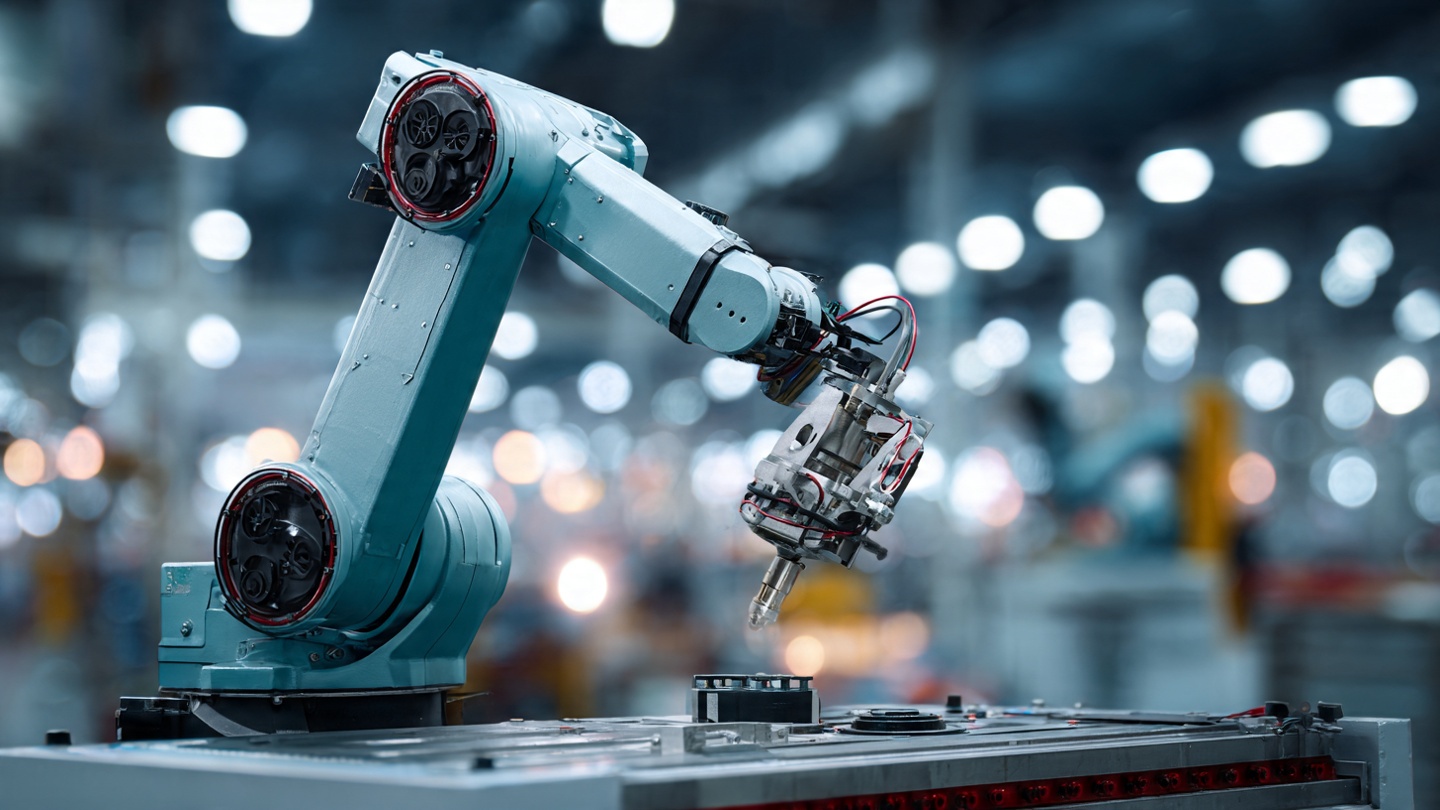
Industrial robotics is where AI really shines because the problem space is constrained. You’re not asking the robot to make coffee and walk the dog. You’re asking it to spot defects on a production line or adjust welding paths based on material thickness.
Tesla’s Gigafactories use AI-powered robots that can learn from each car they work on. If a door panel doesn’t fit quite right, the system adjusts torque and positioning for the next one. That’s machine learning doing actual work.
But here’s the catch: these systems fail in interesting ways. I’ve seen a robot arm “learn” the wrong pattern because someone left a calibration jig in the workspace for two shifts. It started compensating for something that shouldn’t be there. Took us six hours to figure out why suddenly every tenth unit was getting rejected.
Warehouse Automation
Amazon’s putting 520,000 robotic units in their warehouses. That’s not hype; that’s deployed reality. These robots use AI for path planning, obstacle avoidance, and optimizing pick routes.
The interesting part? They’re using something called swarm intelligence. Each robot doesn’t just navigate; it communicates with others to avoid congestion. It’s like if your GPS could tell other drivers to take different routes so you don’t all hit the same traffic jam.
Real talk: this is also why 125,000 warehouse jobs have shifted. Not disappeared (new jobs in robot maintenance popped up), but definitely changed. Anyone saying AI in robotics has zero impact on employment is selling you something.
Healthcare Robotics
Surgical robots like the da Vinci system now incorporate AI for things like tremor filtering and motion scaling. A surgeon makes a 2-inch hand movement; the robot makes a 0.2-inch precise cut.
But (and this is important) these aren’t autonomous. The AI assists; it doesn’t decide. And that’s deliberate. I talked to a surgical robotics engineer who said the liability questions alone would kill full autonomy. Not to mention the ethical issues around decision-making in AI systems.
The Tech Stack Behind Robot Brains

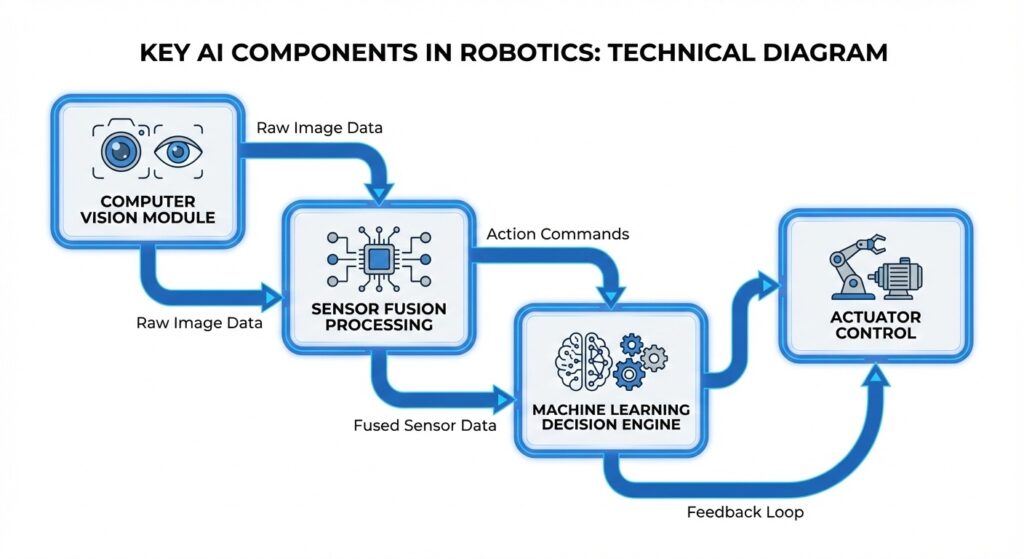
Let me break down what actually makes these things work without getting too deep into the weeds.
Computer Vision
Most useful robots need to see. That means cameras, LIDAR, depth sensors, and a whole lot of computer vision algorithms processing that data.
I spent two weeks debugging why our robot kept identifying cardboard boxes as humans. Turns out, the training dataset had too many images of people wearing brown. The AI generalized “brown rectangular thing” as “probably a person.”
That’s real AI development. Not magic; just pattern matching gone weird.
Reinforcement Learning
This is where robots learn by doing. You set up a reward system, and the robot tries different approaches to maximize the reward.
Boston Dynamics (the backflipping robot dog people) uses reinforcement learning for locomotion. The robot tries thousands of different walking patterns in simulation, falls down a lot, and eventually learns what works.
The downside? It takes massive computing power and time. These models train on server farms, not on the robot itself. Want to learn more about how this works? Check out our guide on reinforcement learning.
Sensor Fusion
Here’s where it gets interesting. Modern robots combine data from multiple sensors (cameras, accelerometers, gyroscopes, force sensors) and use AI to make sense of all of it together.
That Amazon warehouse robot I mentioned earlier? It’s using visual data, LIDAR mapping, and wheel encoders simultaneously. The AI has to decide which sensor to trust when they disagree. Because they will disagree. Sensors are liars.
What Actually Works Today
Let’s be specific about what’s deployed versus what’s in demo videos.
Working right now:
- Collaborative robots (cobots) that can work safely next to humans without cages
- Autonomous mobile robots in warehouses (over 100,000 deployed)
- Agricultural robots for weeding and harvesting specific crops
- Robotic vacuum cleaners that don’t get stuck under your couch (mostly)
Still mostly in labs:
- Humanoid robots doing general household tasks
- Fully autonomous construction robots
- Robots that can handle any object without specific training
- The “general purpose” robot that does everything
The Problems Nobody Talks About
Edge Cases Will Destroy You
AI models train on typical scenarios. Robots encounter atypical scenarios constantly. A warehouse robot trained on flat, clean floors will absolutely freak out when someone spills coffee or leaves a pallet partially blocking an aisle.
We had to add a “confusion threshold” where if the robot’s confidence score drops below 60%, it just stops and calls for help. Smarter than having it guess.
Maintenance Is Expensive
These aren’t traditional industrial robots where you replace a bearing every 10,000 hours. AI systems drift. Models degrade. You need people who understand both mechanical systems and machine learning to keep them running.
Our maintenance costs ran about 30% higher than we budgeted. And we’d budgeted 40% above traditional automation. Do the math.
Training Data Is Never Good Enough
You know what we needed to make our picking robot work? 50,000 images of damaged packaging. Not pristine product photos. Beat-up boxes, torn labels, items at weird angles.
Getting that data took four months. Training the model took three days. That ratio is pretty typical.
Where This Is All Heading
Next five years? I think we’ll see:
- More cobots in small manufacturing: The prices are dropping, and SMBs can actually afford them now
- Delivery robots in cities: Already deployed in some places; regulations are catching up
- AI making existing robots smarter: Most industrial facilities won’t replace robots; they’ll upgrade the software
What won’t happen? Robot butlers. Full autonomy in uncontrolled environments. Skynet.
The hype cycle has settled into “useful but limited.” And honestly? That’s fine. We don’t need robots that do everything. We need robots that do specific things really well.
Should You Care About This?
If you’re in manufacturing, logistics, or healthcare, you should absolutely be paying attention. This tech is mature enough to deploy, but immature enough that early adopters get competitive advantages.
If you’re worried about job displacement, yeah, it’s real. But it’s slower and different than people think. The warehouse workers aren’t all gone; they’re working different jobs. Often better-paying ones (robot maintenance tech beats box stacker on the resume).
And if you’re a developer? There’s real work here. Companies are desperate for people who understand both robotics and AI. You don’t need a PhD. You need practical experience and willingness to debug weird edge cases at 2 AM.
Because that’s what this field actually is: practical problem-solving with expensive hardware that sometimes does unexpected things.
The Bottom Line
AI in robotics isn’t about creating human-like machines. It’s about making special-purpose machines that can handle variability and uncertainty. That’s it.
The robots that work are narrow, task-specific, and operating in controlled environments. The ones that fail are trying to do too much or operating in chaos.
If you want to explore more about the algorithms powering these systems or the broader applications of AI technology, we’ve got guides that go deeper.
Just remember: every impressive robot demo video you see represents thousands of hours of training, testing, and failures you don’t see. That’s the real story of AI in robotics.