AI in E-Commerce: How Machine Learning Actually Changes Online Shopping (And Where It Still Fails)
I’ll be honest with you. When I first heard “AI-powered recommendations” back in 2018, I rolled my eyes. Hard. Another buzzword, right?
Then I watched a mid-size e-commerce client increase their average order value by 34% in three months. Just by implementing a halfway decent recommendation engine.
That got my attention.
So here’s what I’ve learned after working with five different e-commerce platforms and their AI implementations. The good, the broken, and the “why is it recommending cat food to someone buying a laptop?”
What AI Actually Does in E-Commerce (Beyond the Marketing Hype)
Look, every e-commerce platform claims they’re “AI-powered” now. Most of them are just running basic collaborative filtering and calling it machine learning. But when AI is done right? It fundamentally changes how online stores operate.
The three areas where I’ve seen real impact:
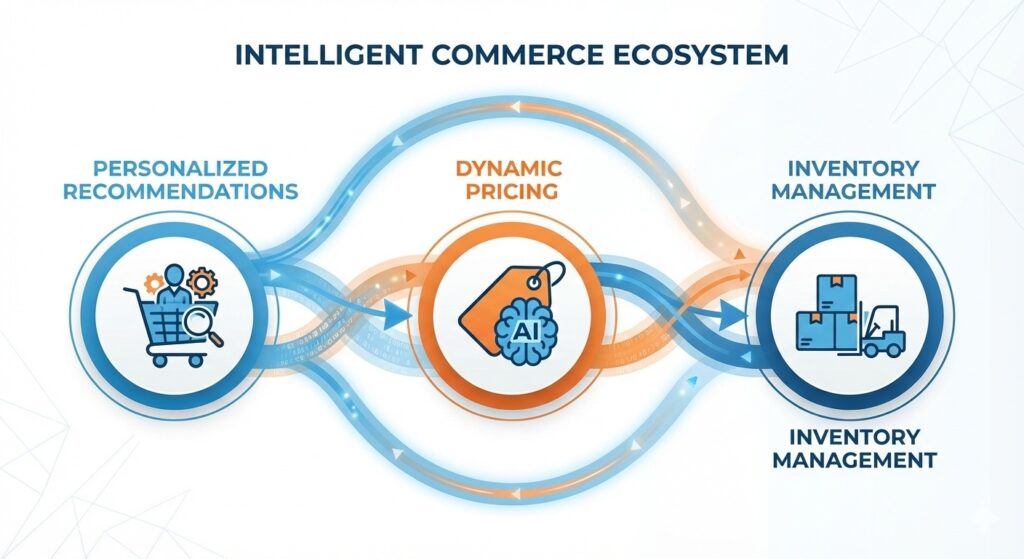
1. Personalized Product Recommendations
This is the big one. And it’s not just “people who bought this also bought that” anymore. Modern recommendation systems analyze browsing patterns, purchase history, time spent on pages, even cart abandonment behavior.
I worked with a fashion retailer last year. Their old rule-based system would show “related products” based on categories. Bought a dress? Here are more dresses. Revolutionary.
We implemented a neural network model that considered style preferences, price sensitivity, and seasonal trends. It started suggesting accessories, shoes, complementary items. Average order value jumped from $67 to $89.
But here’s what nobody tells you: you need at least 50,000 user interactions before these models start performing better than simple rules. Below that? You’re wasting time and money.
2. Dynamic Pricing
This one makes some people uncomfortable. AI systems that adjust prices based on demand, competitor pricing, inventory levels, and user behavior.
Amazon does this constantly. I mean constantly. Prices can change multiple times per hour. A client tried implementing this and crashed their site for six hours because they didn’t rate-limit the pricing API calls. Ask me how I know.
The sweet spot we found? Update prices twice daily during normal periods, hourly during high-demand events. Test your infrastructure first.
3. Inventory Management and Demand Forecasting
This is where AI saves serious money. Predicting which products will sell, when, and in what quantities.
I consulted for an electronics retailer who was drowning in unsold phone cases while constantly running out of charging cables. Their buyers were making gut-feel decisions.
We built a forecasting model using historical sales data, search trends, and seasonal patterns. First quarter after implementation? Overstock reduced by 41%, stockouts down 28%.
The model was wrong sometimes. But it was consistently less wrong than humans guessing.
The Automation Side (Where Things Get Interesting)
Chatbots and Customer Service
Everyone’s building chatbots now. Most of them suck.
I’ve implemented three chatbot systems. Two failed spectacularly. The one that worked? We gave it a very narrow scope: order tracking, return status, and basic product specs. That’s it.
The failures came from trying to make the bot handle complex questions. “Is this jacket waterproof?” depends on definitions, use cases, and expectations. The bot would hallucinate features or give contradictory answers.
Here’s my rule: automate the boring, repetitive stuff. Route complex questions to humans. Don’t try to replace your support team with GPT and hope for the best.
Image Recognition for Visual Search
This technology is actually pretty solid now. Upload a photo of a chair, find similar products in the catalog.
A furniture client implemented this last spring. Visual search accounted for 12% of their mobile traffic within two months. Conversion rate was 2.3x higher than text search.
The catch? You need clean, consistent product photography. We spent six weeks cleaning their image database before launching. Garbage in, garbage out applies here too.
Automated Email Marketing
This is where AI shines without much downside. Product recommendation emails, cart abandonment reminders, personalized promotions.
I’ve seen open rates improve from 14% to 31% just by letting the AI decide send times based on individual user behavior patterns.
One thing that bit us: the AI discovered that sending emails at 2 AM converted well for a small segment of users. Turns out they were international customers in different time zones. The system didn’t account for that. We had to add geographic logic on top of the behavior predictions.
Real-World Problems I’ve Encountered
Let me share some failures so you don’t repeat them.
The Recommendation Loop of Death
Client sold industrial parts. AI recommendation engine started suggesting the same three popular items to everyone. Why? The model trained on purchase data, popular items sold more, model recommended them more, they sold even more, feedback loop.
Took us three weeks to notice. Had to add diversity constraints to prevent the model from playing it too safe.
Privacy Theater
Implemented cookie-less AI recommendations using hashed user IDs. Worked great technically. Then we realized we were technically GDPR compliant but still creeping users out with eerily accurate suggestions.
Added an explicit “use my browsing history for recommendations” toggle. Opt-in rate was 68%, conversion rate on opted-in users was 40% higher. Everyone won.
The Chatbot Apologized Itself to Death
Customer service bot we launched would apologize for everything. “I’m sorry, let me help you with that.” “I apologize for the confusion.” “Sorry, I don’t understand.”
After two weeks, customers hated it. Not because it was wrong, but because constant apologizing made the brand seem weak and unreliable.
We reprogrammed it to be more direct and confident. Customer satisfaction improved immediately.
What You Actually Need to Get Started
If you’re thinking about adding AI to your e-commerce platform, here’s the honest breakdown.
For Personalized Recommendations:
- At least 10,000 monthly active users (below this, use rules)
- Clean product catalog with consistent tagging
- 6-12 months of user interaction data
- Budget around $15k-$50k for implementation
- Ongoing: about $500-$2000/month depending on traffic
I’ve worked with Recombee and Amazon Personalize. Both solid. Recombee’s cheaper for mid-size stores. Amazon Personalize works better at scale but you’ll need a developer who understands AWS.
For Chatbots:
- Start with Zendesk AI or Intercom’s Resolution Bot
- Don’t build custom unless you have $100k+ budget
- Begin with 5-7 specific use cases, expand slowly
- Have human handoff ready from day one
For Dynamic Pricing:
- Prisync or Omnia Retail for competitor monitoring
- Be careful with race-to-bottom scenarios
- Set price floors, don’t let AI crater margins
- Test on 10-20% of products first
The Future (And Why I’m Skeptical of Some of It)
Generative AI for product descriptions? Sure, saves time. I use it. But you need human review unless you enjoy lawsuits about made-up product features.
Virtual try-on with AR? Cool tech, but adoption rates are still under 5% in most categories I’ve tracked. Don’t bet the farm on it yet.
Voice commerce? Everyone’s been predicting this for five years. Still hasn’t happened. People don’t want to read their credit card numbers out loud to Alexa.
What I am excited about: better fraud detection, supply chain optimization, and more accurate demand forecasting. The boring stuff that actually saves money.
Bottom Line
AI in e-commerce isn’t magic. It’s math, data, and a lot of testing.
Start small. Pick one area. Measure everything. Don’t trust vendor promises. And for the love of all that’s holy, have human oversight.
I’ve seen AI increase revenue by 40% and tank it by 20%. The difference? Implementation quality, realistic expectations, and continuous monitoring.
This is just one piece of understanding artificial intelligence in practical applications. For a deeper dive into how AI works across different industries, check out our comprehensive guide on artificial intelligence and machine learning.
Want to understand the technology behind these recommendations? Read about machine learning basics to see how these algorithms actually work. And if you’re curious about how AI makes predictions about customer behavior, our article on predictive analytics with AI covers exactly that.
Looking at other industries using AI? Check out how AI in marketing is changing customer engagement strategies, or explore AI in finance to see similar applications in a different sector.
Real talk: If you’re running an online store with less than $500k annual revenue, focus on basic analytics and good product photos first. AI can wait. If you’re above that and not using any AI tools yet? You’re leaving money on the table.