AI Programming Languages: Which One Should You Actually Learn?
So you want to build AI stuff. Great. First question everyone asks: “What language should I learn?”
I’ve been writing code for seven years now, and I’ll tell you what nobody mentioned when I started: the language matters way less than you think, but way more than the tutorials admit.
Here’s the thing. I wasted six months learning Java for AI because some university course said it was “enterprise-ready.” You know what happened? I built exactly zero AI projects with Java. Meanwhile, my colleague who learned Python in three weeks was already deploying models to production.
Let me save you the detour.
Why Programming Languages Matter for AI (But Not How You Think)
Look, any Turing-complete language can technically do AI. But that’s like saying you can technically dig a swimming pool with a spoon.
The real question isn’t “can this language do AI?” It’s:
- Does it have the libraries you need already built?
- Will you spend more time fighting the language or solving problems?
- Can you actually find help when you’re stuck at 2 AM?
I learned this the hard way when I tried building a neural network from scratch in C++. Sure, I understood every pointer and memory allocation. I also spent three weeks on something PyTorch does in 10 lines.
Python: Yeah, Everyone Says This for a Reason
What it’s actually good for: Pretty much everything AI-related
I resisted Python at first. Seemed too simple. Too slow. Too… popular?
Then I tried building a sentiment analysis tool. In Python, it took me an afternoon. The equivalent in my “preferred” language would’ve been a week-long project.
Why Python Dominates AI
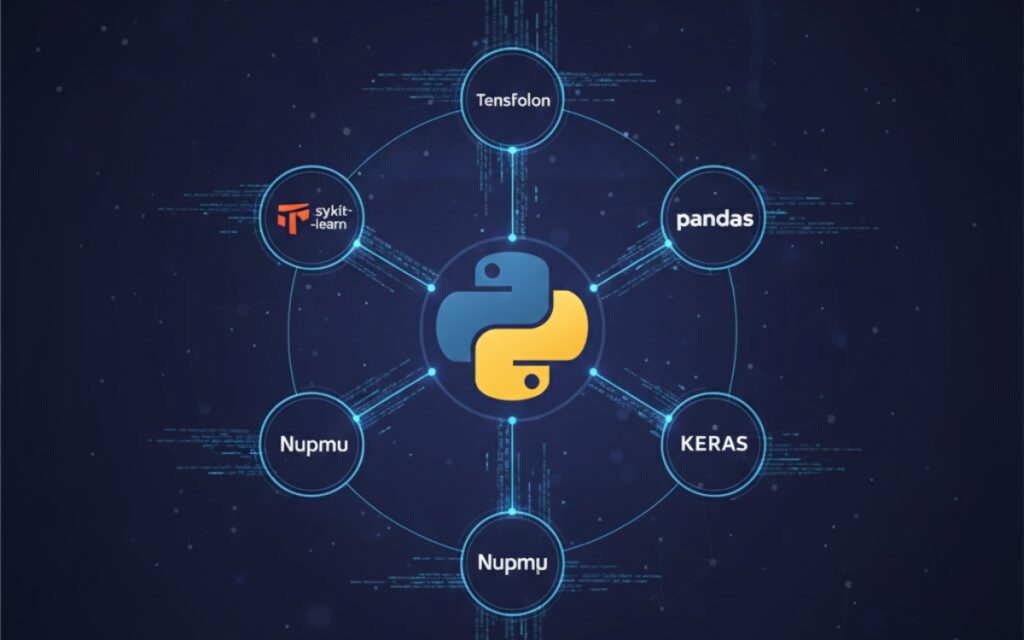
It’s not just hype. Here’s what makes Python actually useful:
The library ecosystem is ridiculous. TensorFlow, PyTorch, scikit-learn, pandas, NumPy… if someone’s built an AI thing, there’s probably a Python library for it. Last month I needed to implement a recommendation system. Searched for two minutes, found surprise-lib, had a working prototype before lunch.
It reads like pseudocode. When you’re debugging why your model won’t converge at 3 AM (we’ve all been there), you want code you can actually read. Python’s syntax doesn’t fight you.
Everyone uses it. Sounds dumb, but it matters. Stack Overflow has answers. Your coworkers know it. That random GitHub repo you found? Python. This article about machine learning basics? All the code examples? Python.
Python’s Dirty Secrets
But real talk – Python isn’t perfect:
It’s slow. Like, genuinely slow. I once tried processing a 2GB dataset with pure Python. Went to make coffee. Came back. Still running. NumPy saved me, but vanilla Python can be painful.
Packaging is… weird. Virtual environments, pip, conda, poetry, pipenv… there are like six ways to manage dependencies and they all kind of suck in different ways. I still forget to activate my venv at least once a week.
Version chaos. Python 2 vs 3 isn’t an issue anymore (thank god), but libraries break between minor versions all the time. Fun game: try running a 2-year-old ML tutorial without modifying anything.
What You’ll Actually Use Python For
Based on my last two years doing AI work:
- Data preprocessing (pandas is a lifesaver)
- Training models (PyTorch or TensorFlow)
- Quick prototypes (Jupyter notebooks, love/hate relationship)
- Data visualization (matplotlib, seaborn)
- API endpoints for models (Flask, FastAPI)
If you’re serious about AI, learn Python. Fight me.
R: Not Dead, Just Specific
What it’s actually good for: Statistics, data analysis, academic research
I don’t use R often. But when I do, I’m grateful it exists.
When R Makes Sense
R shines for statistical analysis. If you’re doing hypothesis testing, regression analysis, or any academic AI research, R has tools Python’s still catching up to.
I once had to explain model performance to a stats PhD. Sent them Python code. Got back: “Can you do this in R?” Turns out, R’s statistical packages made assumptions explicit that Python glossed over. It mattered.
Also, R’s ggplot2 makes beautiful visualizations. I’m not gonna lie – when I need a publication-quality graph, I sometimes export data to R just for ggplot2.
Why I Don’t Recommend R First
Syntax is… different. Coming from any C-style language, R feels weird. The <- assignment operator. Vector operations everywhere. It’s powerful once you get it, but the learning curve is steeper than Python’s.
Smaller AI ecosystem. R has ML libraries (caret, randomForest, etc.) but they’re not as active or well-documented as Python’s. Trying to implement deep learning? You’ll probably end up using keras, which is just a Python wrapper anyway.
Job market reality. Most AI job postings ask for Python. Some want both. Very few want R exclusively.
The Verdict on R
Learn R if you’re doing heavy statistical work or working in academia. Otherwise? Skip it until you need it. Your time’s better spent getting good at Python first.
Julia: The “Future” That’s Still Coming
What it’s actually good for: High-performance numerical computing
Julia promised to solve Python’s speed problem while keeping readable syntax. In theory, it’s perfect for AI.
I got excited about Julia two years ago. Tried it for a reinforcement learning project. Here’s what happened:
The good: Holy hell, it’s fast. Like, C++ fast. I ran some numerical simulations that were 10x faster than Python. The syntax felt natural coming from Python. Multiple dispatch is genuinely clever.
The bad: The package ecosystem is tiny compared to Python. Documentation ranges from “excellent” to “read the source code.” I spent two days trying to figure out why my GPU wasn’t being utilized. Found the answer in a GitHub issue from 2019.
Should You Learn Julia?
Maybe? If you’re:
- Doing serious numerical computing
- Working on AI research where performance matters
- Patient with rough edges
Otherwise, stick with Python and optimize later. I’ve shipped probably 20 AI projects. Used Julia for exactly one.
JavaScript/TypeScript: Surprisingly Useful
What it’s actually good for: Running models in browsers, edge devices
Yeah, JavaScript for AI sounds weird. I thought so too.
Then I needed to run a model client-side in a web app. Turns out, TensorFlow.js exists. Built a real-time image classifier that runs entirely in the browser. No backend needed.
Where JavaScript Actually Works
Web-based ML demos. Users hate installing Python. Browsers are everywhere.
Edge deployment. Running models on phones or IoT devices? JavaScript’s there.
Prototyping UIs. If you’re building tools for non-technical users, web interfaces are easier to share than Jupyter notebooks.
I’ve used TensorFlow.js for:
- A custom image annotation tool
- Real-time pose estimation demo
- Client-side recommendation engine (privacy-friendly, everything local)
JavaScript’s AI Limitations
It’s not for training. Train in Python. Export to JavaScript. That’s the workflow.
Performance constraints. Browser-based models need to be small and fast. Complex AI algorithms won’t work well.
Debugging is harder. When your Python model misbehaves, you’ve got great tools. When your TensorFlow.js model acts weird? Good luck.
The Languages I Don’t Recommend (And Why)
Java
“Enterprise-ready” means “your startup doesn’t use it.” Java has Deeplearning4j and Weka, but the Python ecosystem is miles ahead. Only use Java if you’re stuck maintaining legacy code.
C++
Fast? Yes. Worth the pain for 99% of AI projects? No. I’ve built exactly one AI thing in C++ (embedded system, no choice). Spent more time chasing memory leaks than improving the model.
MATLAB
Academic licensing nightmare. Python with NumPy does the same thing for free.
What Should You Actually Learn?
Here’s my honest recommendation based on what I wish someone told me:
Start with Python. Get comfortable with:
- pandas for data manipulation
- NumPy for numerical operations
- scikit-learn for traditional ML
- PyTorch or TensorFlow for deep learning
Then add JavaScript if you need web deployment.
Consider R if you’re doing statistical analysis or working with statisticians.
Ignore Julia until you hit performance walls.
I wasted months learning languages I didn’t need. Don’t be me.
The Real Secret Nobody Mentions
Here’s what matters more than which language you choose: Can you build stuff that works?
I’ve seen developers with perfect Python syntax who can’t ship a model. I’ve seen R programmers who barely know Python but solve real problems daily.
The language is just a tool. The hard part is understanding AI for data analysis, knowing when to use which model, and debugging why your accuracy is stuck at 60%.
Learn enough Python to not fight the language. Then focus on learning AI itself.
Start Here
If you’re brand new to AI programming:
- Install Python 3.10+ and PyTorch
- Work through one end-to-end tutorial (kaggle has good ones)
- Build something stupid that interests you
- Get stuck. Google. Learn. Repeat.
I built a bot that predicted whether my coffee would be good based on time of day. Completely useless. Taught me more than three Coursera courses.
For more foundational knowledge, check out our comprehensive guide on Artificial Intelligence and Machine Learning.
Final Thoughts
Python’s not going anywhere. R has its place. Julia’s interesting but not ready. JavaScript’s more useful than you’d think.
But honestly? Stop overthinking the language choice. Pick Python. Start building. You’ll learn more from one failed project than reading a hundred blog posts.
Ask me how I know.
This article is part of our comprehensive guide on Artificial Intelligence and Machine Learning. For more beginner-friendly resources, also check out AI Tools for Beginners.