Machine Learning Basics: What It Actually Is (And Why You Should Care)
This article is part of our comprehensive guide on Artificial Intelligence and Machine Learning. For the full overview of AI concepts and applications, check out the main guide.
You know what’s funny? I’ve been using machine learning for three years, and I still catch myself explaining it wrong at parties.
Not because it’s impossibly complex. But because everyone’s heard the buzzwords (AI! Neural networks! Big data!) and nobody really breaks down what’s actually happening under the hood.
So let me save you from my awkward party moments. Here’s what machine learning really is, minus the marketing fluff.
What Is Machine Learning, Really?
Traditional programming is straightforward. You write explicit rules. “If the user clicks this button, do that thing.” Simple cause and effect.
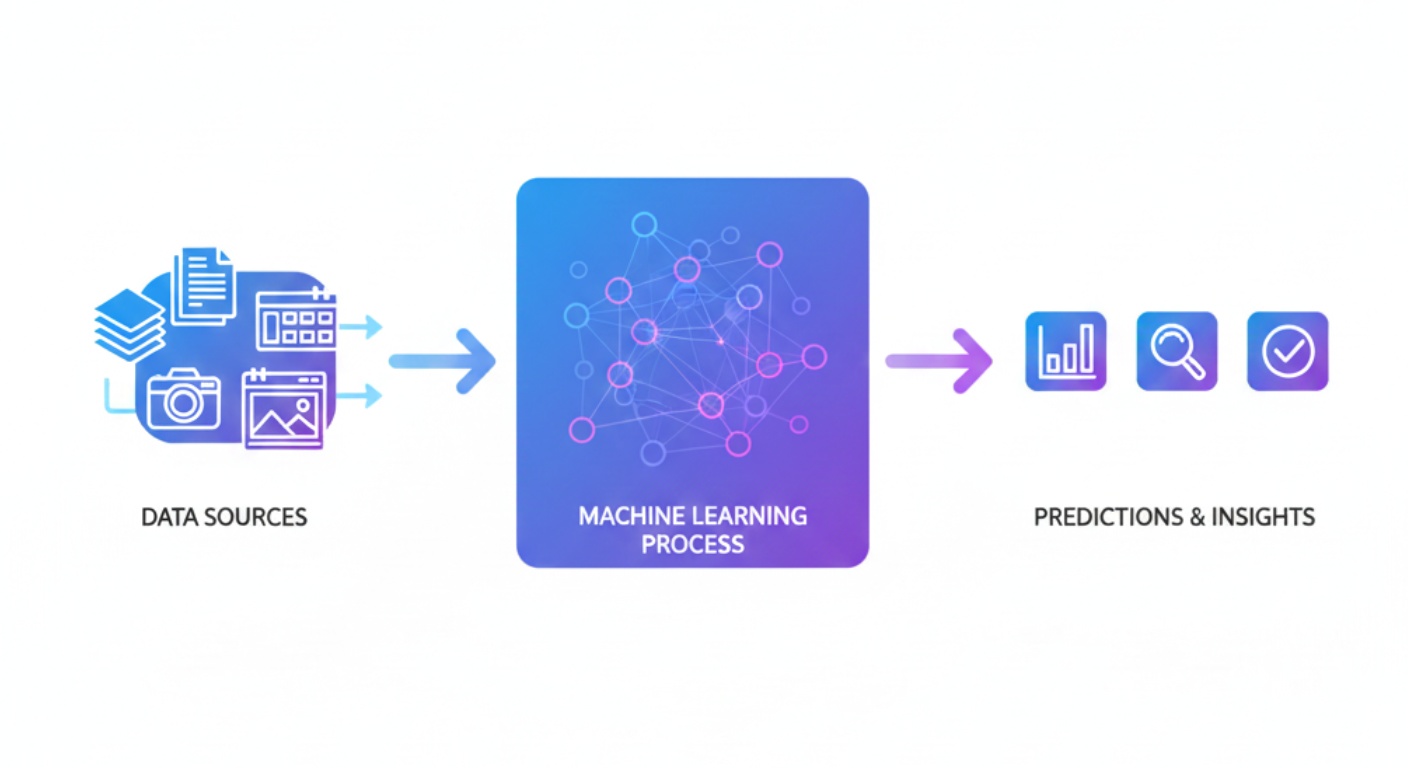
Machine learning flips this. Instead of writing rules, you feed a system tons of examples. The system figures out the patterns itself.
Here’s a real example that clicked for me: Remember spam filters? In the ’90s, developers wrote rules like “if email contains ‘Nigerian prince’, mark as spam.” But spammers adapted. They’d write “N1ger1an pr1nce” and boom, filter bypassed.
Machine learning changed the game. You show the system 10,000 spam emails and 10,000 legitimate ones. It learns patterns you’d never think to code. Maybe spam emails have shorter sentences. Or they use certain word combinations. Or they’re sent at specific times.
You don’t tell it these rules. It finds them.

The Three Types You’ll Actually Encounter
Look, there are technically more than three types, but in practice? You’ll see these three everywhere.
Supervised Learning
This is the “here’s the answer key” approach. You give the system labeled data. “This email is spam. This one isn’t.” The system learns to predict labels for new data.
I used this last year to predict which customer support tickets needed urgent attention. Fed it 50,000 old tickets (with their priority labels), and it got scary good at flagging the ones that would escalate.
Unsupervised Learning
No answer key this time. You dump data on the system and say “find patterns.” It’s like asking someone to organize a messy closet without telling them how.
Clustering is the classic example. Feed it customer purchase data, and it might discover “oh, these 5,000 customers all buy the same product combinations.” You just found a market segment you didn’t know existed.
Reinforcement Learning
This one’s different. The system learns by trial and error, getting rewards for good actions and penalties for bad ones. Like training a dog, but the dog is an algorithm.
AlphaGo (the AI that beat world champions at Go) used this. It played millions of games against itself, learning what moves led to wins. That’s reinforcement learning in action.
How Does It Actually Work?
I’m going to skip the heavy math because honestly? You don’t need calculus to understand the concept. Here’s the simple version.
Step 1: Get Data
Lots of it. That’s the fuel. A machine learning model without data is like a car without gas. Going nowhere.
And not just any data. Good data. Clean data. I learned this the hard way when I tried to build a model with customer data that had 30% duplicate entries. Model was useless.
Step 2: Choose Your Model
There are tons of algorithms. Linear regression, decision trees, neural networks, support vector machines. Each has its strengths.
For beginners, I always recommend starting simple. Don’t jump straight to deep learning with neural networks. Try a decision tree first. They’re easy to understand and debug.
Step 3: Train the Model
This is where the magic happens. The algorithm processes your data, looking for patterns. It makes predictions, checks if they’re right, adjusts its internal parameters, and repeats. Thousands or millions of times.
Think of it like studying for an exam. First attempt? You bomb it. But you learn from mistakes. By the tenth practice test, you’re acing it.
Step 4: Test and Improve
You can’t test on the same data you trained on. That’s like taking the exact same practice test as your final exam. You’d do great, but you haven’t really learned.
So you split your data. Train on 80%, test on 20%. See how well it performs on data it’s never seen.
My first model had 95% accuracy on training data. I was pumped. Then I tested it on new data and got 60%. That’s called overfitting, and it’s the worst feeling.
Why Should You Care About This?
Here’s the thing: machine learning isn’t just for data scientists anymore. It’s everywhere.
That movie recommendation on Netflix? Machine learning. Your phone’s autocorrect? Machine learning. The route your GPS picks? Machine learning analyzing traffic patterns.
If you’re in tech, you’ll bump into this eventually. Maybe you’ll need to integrate an ML model into your app. Or explain to a client why their “AI solution” isn’t working. Or just understand what your data science team is actually doing.
And honestly? It’s not that hard to get started. There are tools built for beginners that handle most of the complex stuff. You can build a working model in an afternoon.
Common Mistakes (That I’ve Made)
Not Having Enough Data
I tried building a model with 200 examples once. It was garbage. Most problems need thousands of examples minimum. Some need millions.
Ignoring Data Quality
Garbage in, garbage out. I spent a week debugging a model before realizing my training data had a systematic error. Fixed the data, model worked perfectly.
Choosing the Wrong Algorithm
Sometimes you need a sledgehammer, sometimes a scalpel. I’ve seen people try to solve simple problems with complex neural networks. Overkill. Use the simplest thing that works.
Forgetting to Scale
Technical one, but important. If one feature ranges from 0-1 and another from 0-10000, your model will get confused. Normalize your data. Trust me.
Where to Go From Here
If you’re serious about learning this stuff, start with Python. It’s the standard language for machine learning, and there’s a reason. The libraries (scikit-learn, TensorFlow, PyTorch) are mature and well-documented.
Check out our guide on AI programming languages if you want specifics on what to learn. Or dive into AI algorithms if you want to understand the math better.
But honestly? The best way to learn is to build something. Pick a simple problem. Find some data. Try to make predictions. You’ll learn more from one failed project than from reading ten tutorials.
Real Talk
Machine learning isn’t magic. It’s statistics and optimization dressed up in fancy terminology.
It won’t solve every problem. Sometimes a simple if-statement is better than a trained model. And it definitely won’t work if you don’t have good data.
But when it works? It’s pretty damn cool. Watching a model discover patterns you’d never find manually is genuinely exciting. Even after three years, I still get that rush when a model trains successfully.
So yeah. That’s machine learning. No fluff, no hype. Just the basics you need to understand what’s happening when someone talks about “training a model” or “machine learning algorithms.”
Now go build something. And when you inevitably hit a wall (you will), remember: we’ve all been there. That’s how you learn.
Want to dive deeper into AI concepts? Head back to our main Artificial Intelligence and Machine Learning guide for comprehensive coverage of AI topics, applications, and emerging trends.